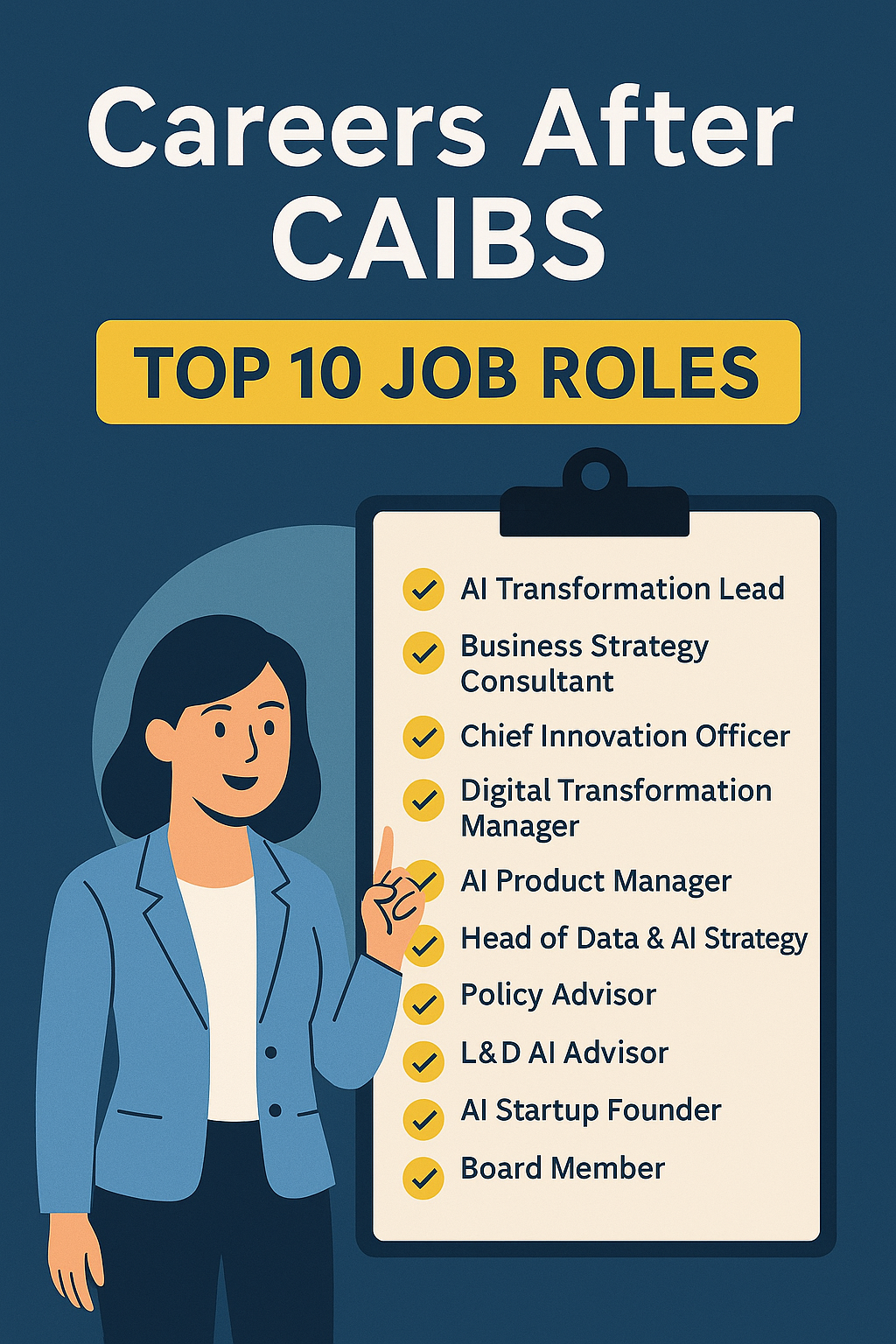
Explore the top 10 high-impact career roles after earning your CAIBS certification. See how certified AI business strategists lead AI transformation across industries.
Completing the Certified AI Business Strategist (CAIBS) program is more than a learning achievement — it’s a launchpad to the most in-demand roles in strategic AI leadership.
Whether you’re upskilling, pivoting, or elevating your role, the careers after CAIBS certification span every sector from finance to healthcare, tech to logistics, and even public policy.
Let’s explore the top 10 job roles you can target once you’re certified.
Why Employers Value CAIBS Graduates
Organisations are actively seeking professionals who:
- Can align AI with business goals
- Understand AI readiness, ROI, and governance
- Can lead AI transformation without coding
This makes CAIBS graduates highly valuable, especially in leadership, product, strategy, and innovation roles.
Top Careers After CAIBS
1. AI Transformation Lead
What You Do:
Drive AI strategy across departments, align executive vision, manage delivery roadmaps, and track AI ROI.
Industries: Tech, banking, government, healthcare
Why You Fit: CAIBS gives you strategic frameworks and planning tools to lead end-to-end initiatives.
2. Business Strategy Consultant (AI-Focused)
What You Do:
Advise clients on AI use cases, business models, and transformation strategies.
Industries: Consulting firms, boutique advisory, freelance/solo
Why You Fit: CAIBS provides the AI Strategy Canvas, Readiness Diagnostics, and case-based credibility.
What Is CAIBS? Discover the Certified AI Business Strategist Program Driving the Future of Work
3. Chief Innovation Officer / Innovation Manager
What You Do:
Lead innovation portfolios, identify AI-driven opportunities, manage risk.
Industries: Manufacturing, retail, telco, fintech
Why You Fit: Module 4 on AI business models and Module 5 on governance are directly applicable.
4. Digital Transformation Manager
What You Do:
Oversee digital transformation with AI as a core pillar.
Industries: Government, finance, logistics, education
Why You Fit: The CAIBS toolkit helps bridge legacy processes with new AI capabilities.
5. AI Product Manager / Strategic Product Owner
What You Do:
Design and oversee AI-enhanced products and user journeys.
Industries: SaaS, health tech, fintech, edtech
Why You Fit: You understand how to position, scope, and govern AI-powered value propositions.
6. Head of Data & AI Strategy
What You Do:
Own strategic direction across AI, analytics, and data operations.
Industries: Enterprises, governments, universities, NGOs
Why You Fit: CAIBS bridges technical and business sides of AI, making you a connector and leader.
7. Policy Advisor (AI & Digital Regulation)
What You Do:
Shape AI governance frameworks, risk assessments, and compliance strategies.
Industries: Public sector, think tanks, NGOs, UN agencies
Why You Fit: Module 5 on ethics and global AI law gives you a solid foundation in regulation.
8. Corporate Learning & Development AI Advisor
What You Do:
Train leaders and staff on AI literacy, strategy, and mindset.
Industries: L&D firms, universities, corporations
Why You Fit: CAIBS provides real-world toolkits you can embed into upskilling programs.
9. AI Startup Founder / Strategic Advisor
What You Do:
Launch or advise startups focused on AI products, platforms, or solutions.
Industries: Startups, accelerators, venture building firms
Why You Fit: You know how to design sustainable business models and pitch value-driven AI use cases.
10. Board Member / Committee AI Advisor
What You Do:
Guide senior leadership on AI investment, risk, and innovation portfolios.
Industries: Corporations, healthcare systems, universities
Why You Fit: As a CAIBS-certified strategist, your insights go beyond tech, they’re grounded in enterprise value.
Sectors Where CAIBS Graduates Thrive
| Sector | Example Roles |
|---|---|
| Finance | AI Strategy Lead, Risk Transformation Advisor |
| Healthcare | Digital Health Strategist, AI Readiness Lead |
| Retail | Omnichannel Innovation Manager, AI Ops Planner |
| Government | Smart Policy Advisor, Data Ethics Officer |
| Education | EdTech Product Owner, AI Pedagogy Consultant |
How to Position Yourself After CAIBS
- Update your LinkedIn headline
“Certified AI Business Strategist | Leading Non-Technical AI Transformation” - Add learning from CAIBS
Showcase your work aligned with industry-specific AI strategy. - Apply to cross-functional roles
Don’t limit yourself to “AI” jobs, you now qualify for strategy, innovation, and digital leadership. - Use the CAIBS alumni network
Connect with peers, share insights, and access referrals.
Salary Expectations
Based on market benchmarks (UAE, UK, US):
| Role | Average Salary (USD/year) |
|---|---|
| AI Transformation Lead | $110,000 – $150,000 |
| AI Strategy Consultant | $80,000 – $130,000 |
| Innovation Manager | $90,000 – $140,000 |
| Policy Advisor (AI Regulation) | $75,000 – $120,000 |
Note: These vary by geography and sector.
Summary: Careers After CAIBS Unlock Strategic Leadership
If you’ve been asking, “What can I do after CAIBS?” the answer is: quite a lot.
With the CAIBS certification, you’re ready to:
- Lead AI transformation in any industry
- Consult, innovate, and design strategy
- Influence governance and shape ethical AI use
- Win credibility — even without a technical background
Ready to Become a Certified AI Business Strategist?
Explore the Full CAIBS Program
Visit The Case HQ for 95+ courses
Read More:
Certified AI Business Strategist (CAIBS): A Complete Guide to AI Strategy Certification
Inside the CAIBS Course: What You’ll Learn in the Certified AI Business Strategist Program
Why CAIBS Is the #1 Choice for AI Business Professionals in 2025
Certified AI Business Strategist (CAIBS): Career ROI That Pays Off Fast
Is CAIBS Right for You? Eligibility & Readiness for the Certified AI Business Strategist Program
Curriculum Deep Dive: Every Module in the CAIBS Program Explained
Learning Outcomes from CAIBS: Real Strategic Impact for AI Business Leaders
Careers After CAIBS: Top 10 Job Roles for Certified AI Business Strategists
https://thecasehq.com/?p=21292&fsp_sid=3627
Comments
Post a Comment