As artificial intelligence continues to reshape education, its impact on research supervision is becoming increasingly evident. One of the most transformative developments is the role of AI in doctoral supervision, where intelligent systems are being used to support, guide, and enhance the PhD journey.
From helping supervisors track student progress to providing real-time feedback on thesis drafts, AI is not replacing human mentors—but rather augmenting their ability to manage complexity, offer tailored support, and improve doctoral completion rates.
The Emergence of Case Studies in Behavioral Sciences
Why AI Matters in Doctoral Supervision
Doctoral supervision is resource-intensive, highly individualised, and time-sensitive. With rising enrolments and increasing workloads on faculty, universities are exploring how AI can complement traditional supervision models.
AI integration helps address challenges such as:
- Delays in feedback cycles
- Inconsistent supervisory support
- Administrative overload
- Isolation and disengagement among doctoral students
By automating routine tasks and providing intelligent insights, AI allows supervisors to focus on high-value mentoring and academic dialogue.
1. AI for Literature Review and Topic Refinement
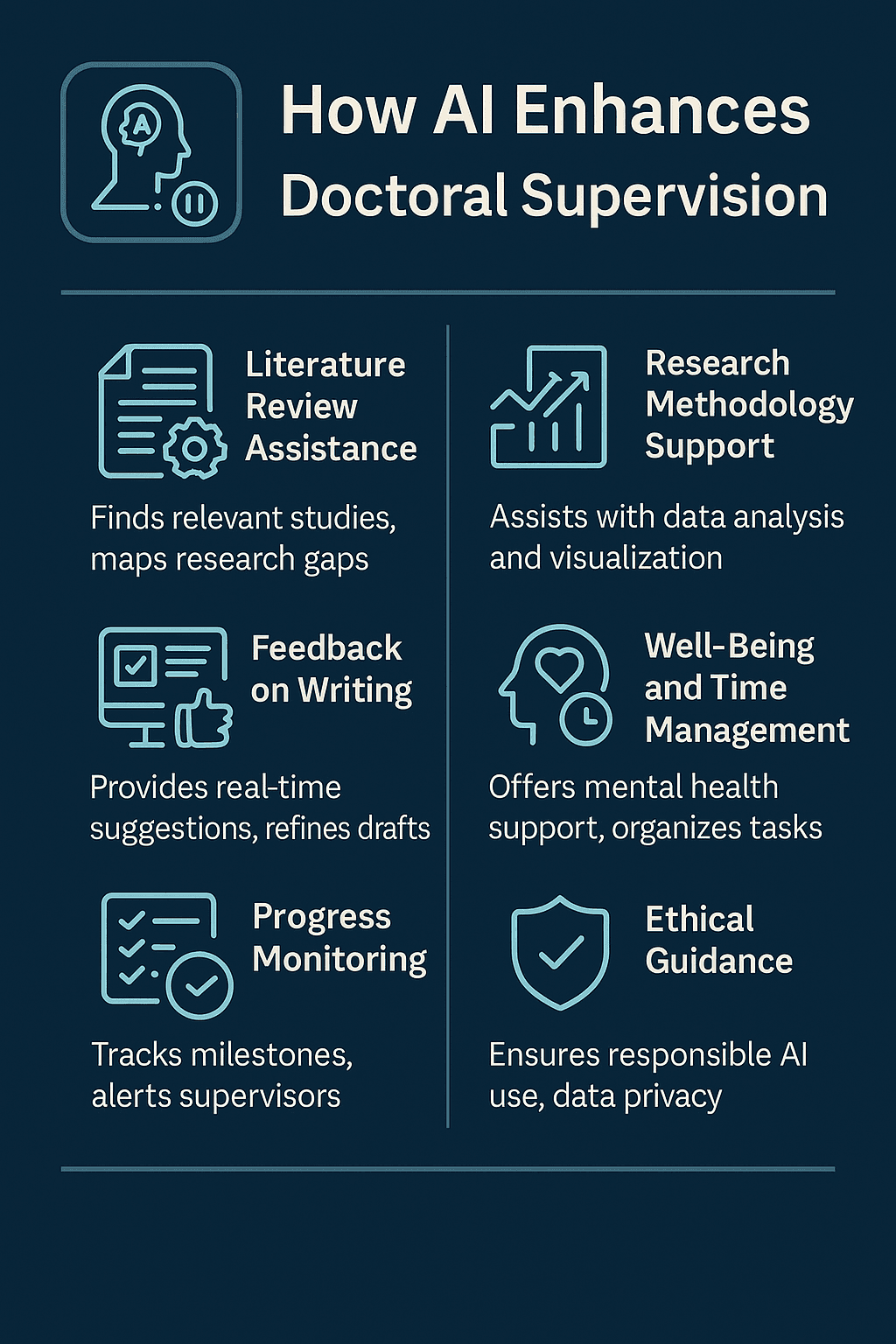
One of the most time-consuming early-stage tasks in any PhD is the literature review. AI tools like Elicit, Semantic Scholar, and Research Rabbit assist students in rapidly identifying relevant studies, summarising key findings, and mapping research gaps.
Use Case:
A PhD student exploring migration policy uses Elicit to compare dozens of articles on refugee integration frameworks across Europe. The AI extracts common methodologies, identifies contradictions, and suggests areas for future research.
Supervisor Benefit:
Supervisors receive better-developed initial drafts and can focus on conceptual refinement instead of basic source review.
2. AI for Feedback on Drafts and Writing
AI-powered writing assistants such as Grammarly, Quillbot, and Jenni AI provide real-time feedback on grammar, structure, and tone—reducing reliance on supervisors for low-level corrections.
More advanced tools like Scite.ai and ChatGPT Pro can help students:
- Clarify arguments
- Improve academic tone
- Refine citations and referencing
- Detect logical gaps
Use Case:
A doctoral student uploads a discussion chapter to Grammarly Premium and receives suggestions on clarity and structure. They then use Quillbot to paraphrase dense sections and ChatGPT to generate questions for deeper reflection.
Supervisor Benefit:
Time is saved on copy-editing, allowing for richer academic feedback during review meetings.
3. AI in Monitoring and Progress Tracking
The role of AI in doctoral supervision also includes administrative support. Smart dashboards and analytics platforms can track milestones, deadlines, and progress on tasks across the PhD timeline.
Use Case:
At some universities, AI is integrated into research management platforms to alert supervisors when students fall behind on key tasks (e.g. ethics submission, literature review chapter).
Supervisor Benefit:
Proactive supervision becomes possible, reducing delays and improving accountability.
4. Enhancing Research Methodology and Data Analysis
AI tools are also making a significant impact on data-driven research. For both qualitative and quantitative approaches, platforms like NVivo, Atlas.ti, and SPSS with AI plug-ins assist in:
- Coding interview transcripts
- Thematic pattern recognition
- Predictive modelling and visualisation
- Automating statistical tests
Use Case:
A sociology student uses NVivo AI to code focus group transcripts and identify cross-cutting themes. This enables more rigorous analysis and better-supported findings.
Supervisor Benefit:
Supervisors can quickly verify analytical integrity and guide students towards more meaningful interpretation.
5. Supporting Mental Well-being and Time Management
The PhD journey is emotionally demanding. AI-driven wellness tools such as Woebot or AI-integrated calendars like Notion AI help students manage anxiety, set routines, and reflect on progress.
Use Case:
A student experiencing isolation during fieldwork uses Woebot for conversational check-ins and schedules focused work blocks with Notion AI reminders.
Supervisor Benefit:
Better-supported students remain engaged, resilient, and on track—reducing the risk of attrition.
6. Ethical and Pedagogical Considerations
While the role of AI in doctoral supervision is promising, ethical considerations must be addressed:
- Data privacy: Confidential research data must be safeguarded when using AI platforms.
- Over-reliance: Supervisors should guide students to use AI as a complement, not a crutch.
- Bias and accuracy: AI outputs can perpetuate misinformation if not critically evaluated.
Universities should provide guidelines for ethical AI usage in research and supervision to maintain academic integrity.
Conclusion
The expanding role of AI in doctoral supervision is not about replacing the human mentor—it is about enabling them to provide deeper, more strategic, and more responsive support to students. AI enhances administrative efficiency, improves writing quality, accelerates literature mapping, and fosters stronger student engagement.
As AI tools continue to evolve, supervisors and institutions must adopt a balanced and ethical approach to ensure these technologies serve the pedagogical purpose of doctoral education. With the right integration, AI can transform supervision into a smarter, more supportive, and more effective experience.
Visit The Case HQ for 95+ courses
Read More:
Navigating Case Studies in AI and Machine Learning
The Impact of Case Studies on Women’s Empowerment Initiatives
How Case Studies Influence Political Campaign Strategies
Decoding Business Transformation through Case Studies
Case Study as Bridging the Gap in Mental Health Research
AI and Special Education: Customizing Learning for Every Student
The Art of Crafting Compelling Case Studies: Tips for Success
How to Use Case Studies to Showcase Your Expertise
A Step-by-Step Guide to Writing Impactful Business Case Studies
The Role of Case Studies in Academic Research: Best Practices
https://thecasehq.com/emerging-trends-the-role-of-ai-in-doctoral-supervision/?fsp_sid=2141
Comments
Post a Comment