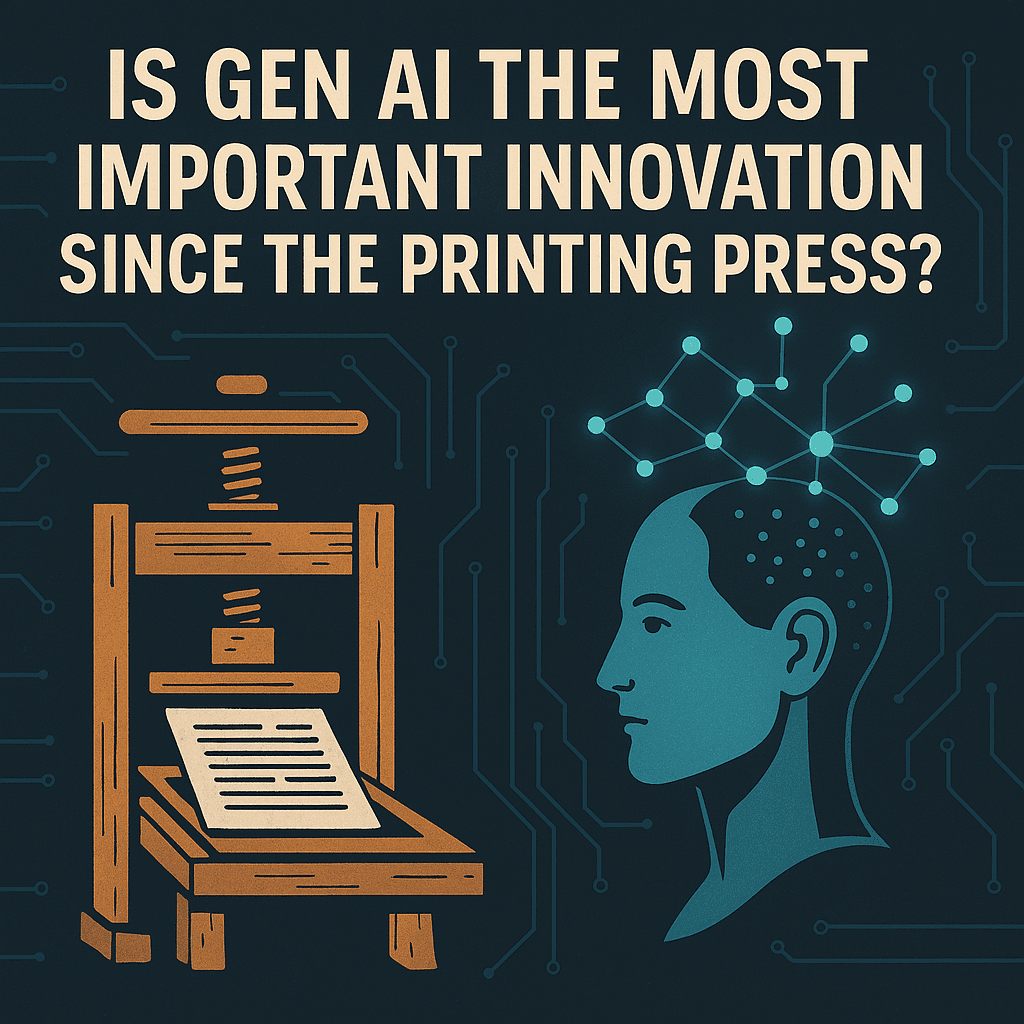
The question “Is Gen AI the most important innovation since the printing press?” is generating intense debate across industries, from education and business to creativity and entertainment. Generative AI—such as ChatGPT, Claude, Gemini, and Bard—has rapidly transformed how we create, communicate, and learn. But is it truly as revolutionary as the printing press, which enabled mass communication and literacy on a global scale?
Comparing Generative AI (Gen AI) to the printing press—one of the most impactful inventions in human history—is no small claim. However, the parallels are striking: both technologies democratise information, accelerate creativity, and challenge established norms.
Successful Case Studies in Healthcare: What Can We Learn?
Why Generative AI Is Being Compared to the Printing Press
To understand why people are asking if Gen AI is the most important innovation since the printing press, it’s essential to consider what the printing press achieved. Invented by Johannes Gutenberg in the 15th century, the printing press enabled the mass production of books, making knowledge accessible to a much wider audience. It catalysed the Renaissance, the Reformation, and the Scientific Revolution.
Generative AI is similarly poised to revolutionise the dissemination of knowledge, creativity, and problem-solving through automation and augmentation.
How Generative AI Transforms Communication and Creativity
Generative AI tools have rapidly infiltrated industries that rely on creativity, communication, and information management.
1. Education and Learning
Is Gen AI the most important innovation since the printing press in education? Many argue it could be.
Example:
Universities like Harvard and Stanford are incorporating AI tools like ChatGPT into their curricula to assist with research writing, enhance critical thinking, and provide real-time feedback on assignments. These tools democratise access to knowledge, much like the printing press once did by making textbooks widely available.
2. Content Creation and Creativity
In the realm of creativity, Gen AI is reshaping how content is produced, from art and literature to marketing and advertising.
Example:
AI tools like DALL·E and Midjourney can generate stunning visual art from text prompts, expanding the creative possibilities for artists and marketers. Similarly, writers are using ChatGPT to generate content ideas, improve clarity, and refine language.
This new era of creativity is reminiscent of the printing press’s impact on literature, art, and scientific communication.
3. Communication and Collaboration
The printing press revolutionised how information was shared and discussed. In a similar vein, Generative AI enables rapid, efficient communication across digital platforms.
Example:
Businesses are using Gemini AI to generate detailed reports, marketing plans, and even customer interactions. This automation frees up time for professionals to focus on more strategic tasks, just as the printing press allowed thinkers to focus on producing content rather than laboriously copying manuscripts.
Why Generative AI Might Not Be the Most Important Innovation Since the Printing Press
Despite the impressive capabilities of Generative AI, there are reasons to question whether it truly matches the impact of the printing press:
- Access Gaps:
Unlike the printing press, which made knowledge widely accessible, Generative AI remains inaccessible to large portions of the global population due to technological, economic, or infrastructural barriers. - Ethical Concerns:
Generative AI raises ethical issues around plagiarism, misinformation, and bias. While the printing press disseminated established knowledge, AI creates new content—sometimes without proper attribution or context. - Dependency Risks:
Excessive reliance on AI for creativity and decision-making could potentially undermine human skills and judgment. - Regulation Challenges:
AI development is progressing faster than regulatory frameworks can adapt, creating concerns about misuse and accountability.
Comparing Generative AI and the Printing Press
| Aspect | Printing Press | Generative AI |
|---|---|---|
| Accessibility | Increased literacy and knowledge access globally. | High potential but limited by digital access. |
| Creativity | Enabled mass distribution of literature, art, and science. | Augments creativity through automated generation. |
| Democratisation of Knowledge | Books became widely available. | AI makes information generation easy but not always accurate. |
| Ethical Concerns | Mostly related to censorship. | Issues with plagiarism, bias, and misinformation. |
| Potential Impact | Triggered the Renaissance and Scientific Revolution. | Could redefine creativity, education, and communication. |
Is Gen AI the Most Important Innovation Since the Printing Press?
So, is Gen AI the most important innovation since the printing press? It certainly holds the potential to transform education, creativity, and communication in ways previously unimaginable. However, it also presents new challenges that require careful consideration.
The printing press provided access to existing knowledge, while Generative AI creates knowledge on demand. As AI tools become more advanced and accessible, their impact may indeed rival that of Gutenberg’s invention. The key difference will be how society chooses to leverage this technology—ethically, creatively, and inclusively.
Visit The Case HQ for 95+ courses
Read More:
Unraveling the Mystery of Case Studies in Psychology
The Role of Case Studies in Environmental Impact Assessments
Why Research Publications are Critical in Understanding Global Health Trends
Exploring the Real-World Impact of Case Studies in Urban Planning
Breaking Down a Case Study: An Interactive Walkthrough
How to Cite Case Studies and Research Publications in Your Work
Innovative Practices: How Case Studies Influence Product Design
Case Studies in Economics: A Closer Look
Utilizing Case Studies for Effective Disaster Management
AI-Powered Learning: Enhancing Student Engagement and Outcomes
Ethical Considerations of AI in Education: Balancing Innovation and Privacy
Leveraging AI for Student Success: Tools and Techniques
The Role of Artificial Intelligence in Personalized Education
https://thecasehq.com/groundbreaking-or-overhyped-is-gen-ai-the-most-important-innovation-since-the-printing-press/?fsp_sid=2119
Comments
Post a Comment