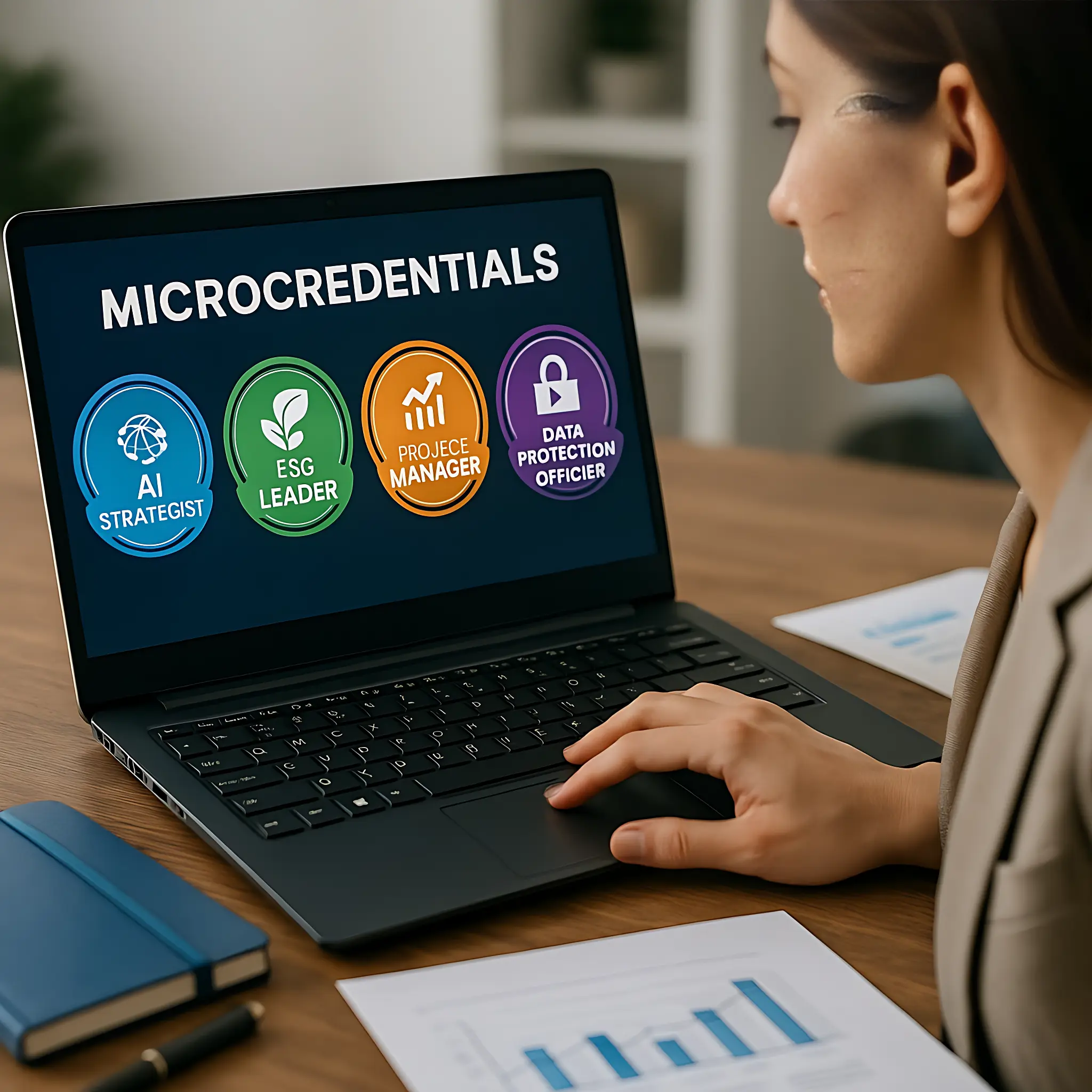
In a world where technology evolves faster than traditional degrees, professionals are turning to faster, more focused, and job-relevant ways to learn. Enter: microcredentials.
Microcredentials are compact, skills-based certifications that validate knowledge in a specific area — whether it's AI strategy, data privacy, instructional design, or sustainable leadership. They're typically self-paced, online, and stackable, making them ideal for the realities of modern careers.
In 2025, microcredentials are no longer a trend — they're becoming the foundation of professional growth. In this article, we explore why microcredentials matter, who they’re for, how they compare to degrees, and how platforms like TheCaseHQ.com are leading the transformation.
What Is a Microcredential?
A microcredential is a short, focused certification designed to teach and validate a specific skill, competency, or area of knowledge.
Unlike traditional degrees that span 2–4 years, microcredentials are:
- Skill-based
- Flexible
- Verifiable
- Often stackable (can build toward broader qualifications)
Examples include:
- “Certified AI Business Strategist”
- “AI for HR Professionals”
- “Project-Based Learning Design”
- “ISO/IEC 42001 Awareness for AI Governance”
- “Certified Data Protection Officer (CDPO)”
Why Microcredentials Are Exploding in Popularity
1. Time-Efficient and Focused
In-demand professionals don’t have time for full degrees. Microcredentials allow learners to upskill in weeks, not years, without stepping away from work.
2. Career-Relevant and Practical
Unlike generic academic courses, microcredentials are aligned with job functions, industry needs, and emerging technologies — from AI ethics to ESG reporting.
3. Cost-Effective
While traditional degrees can cost $20,000+, many microcredentials range from $50 to $500, making them accessible to learners in every region and sector.
4. Stackable and Modular
You can combine microcredentials across themes or levels to build a personalised learning pathway — e.g., AI Governance → Strategic AI Deployment → AI Communication.
5. Digital and Verifiable
Many come with digital badges that can be shared on LinkedIn, resumes, or professional profiles — instantly showcasing your expertise.
Microcredentials vs Degrees: A 2025 Perspective
| Feature | Microcredentials | Traditional Degrees |
|---|---|---|
| Duration | Weeks to months | 2–4 years |
| Format | Online, self-paced | Classroom, hybrid |
| Cost | Low ($50–$500) | High ($10k–$50k) |
| Focus | Specific skills | Broad, theoretical |
| Assessment | Projects, case studies, quizzes | Exams, papers, projects |
| Recognition | Increasing globally | High but sometimes outdated |
| Ideal For | Career changers, upskillers, professionals | Early-career, academic pathways |
Bottom line: Degrees show potential. Microcredentials show readiness.
Who Should Pursue Microcredentials?
Microcredentials are ideal for:
- Mid-career professionals needing to stay current
- Executives and managers leading transformation (e.g., AI, ESG, digital)
- HR and L&D teams building internal capabilities
- Job switchers and career returners
- Freelancers and gig professionals building credibility
- Educators modernising their instructional methods
Industries Where Microcredentials Are Making a Big Impact
Technology & AI
- AI business strategy
- Prompt engineering
- AI governance and risk management
Education & Learning Design
- Case-based teaching
- Digital pedagogy
- Online course creation
Healthcare
- Digital health strategy
- Patient experience mapping
- AI in clinical workflows
Public Sector
- Policy innovation
- Smart city planning
- Responsible AI deployment
Sustainability & ESG
- Climate risk disclosure
- Circular economy models
- Sustainable leadership
Tip: TheCaseHQ’s case-based microcredentials combine all of the above with real-world simulation and templates.
Real-World Example: Strategic Microcredential Use
Profile: Fatima, a marketing manager in the UAE.
Goal: Transition into an AI product strategy role.
Pathway:
- Completes Certified AI Business Strategist (CAIBS) on TheCaseHQ
- Earns digital badge and adds to LinkedIn
- Uses case-based toolkit to lead AI pilot in her team
- Gets promoted to AI integration lead within 6 months
“It was faster and more practical than any degree I’ve done — and the ROI was instant.”
Microcredentials and the Future of Work
By 2030, more than 1 billion people will need to reskill, according to the World Economic Forum.
Employers are moving from degree-based hiring to skill-based hiring. Platforms like LinkedIn and Indeed already let users filter by skills and credentials, not just job titles or degrees.
Microcredentials support:
- Lifelong learning
- Agile career development
- Portable, cross-border expertise
- Rapid adaptation to change
How to Choose the Right Microcredential
Ask:
- Does it solve a specific challenge in your career?
- Is it offered by a credible provider?
- Does it include real-world application?
- Can you complete it in under 8 weeks?
- Will you walk away with something you can use immediately?
Final Thoughts: Don’t Wait for the Future — Learn Into It
The old model of “learn, graduate, work forever” is gone.
The new model is learn, work, upskill, evolve — continuously.
Microcredentials make that not just possible — but efficient, affordable, and aligned with how professionals live and work in 2025.
If you want to lead — not just keep up — now is the time to invest in short-form, high-impact learning.
Ready to Start?
Browse microcredentials in AI, data protection, HR, and more at TheCaseHQ.com.
Visit The Case HQ for 95+ courses
Read More:
Careers After CAIBS: Top 10 Job Roles for Certified AI Business Strategists
Certified AI Business Strategist: Real-World Impact Across Industries
How AI Is Transforming Executive Leadership in 2025
How Case Studies Build Strategic Thinking in Online Learning
From Learning to Leading: Using Case Studies in Executive Education
Best Practices for Integrating Case Studies in Online Courses
Case Method vs Project-Based Learning: What Works Better in 2025?
How to Upskill in AI Without a Technical Background
https://thecasehq.com/why-microcredentials-are-the-future-of-professional-growth/?fsp_sid=3904
Comments
Post a Comment