The demand for AI Roles has skyrocketed in 2025. From AI product managers to ethics officers, employers are actively seeking professionals who can bring artificial intelligence into real-world business solutions. But here’s the big question many job-seekers have: What does it actually take to get hired in AI?
The answer is not always a computer science degree or years of coding experience. What employers value most is evidence of applied skills — often demonstrated through case studies and real projects.
This article shares real case studies that got people hired in AI roles across different industries. Each story highlights the project, skills applied, and hiring outcome offering you a roadmap to replicate.
Why Case Studies Matter for Landing AI Roles
When applying for AI roles, employers don’t just want to see certificates or theory. They want:
- Practical application – Can you use AI tools to solve problems?
- Portfolio evidence – Have you built or applied AI in a tangible way?
- Domain expertise – Can you connect AI with industry-specific needs?
Case studies are the bridge between your learning and an employer’s confidence. They show that you can turn AI knowledge into measurable impact.
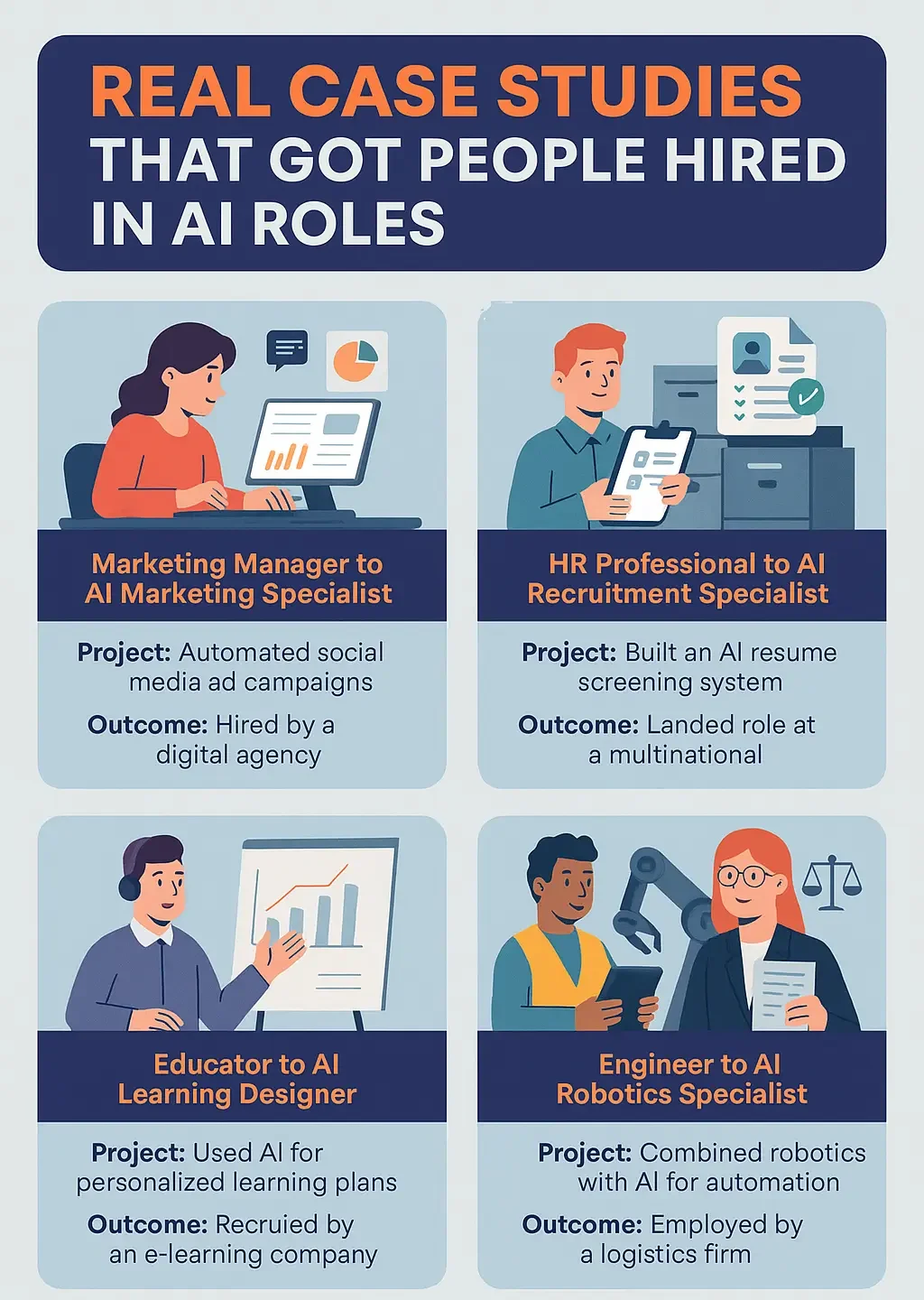
Case Study 1: From Marketing Manager to AI Marketing Specialist
Background: Sarah, a mid-level marketing manager with no tech degree.
Project: She used ChatGPT, Jasper AI, and Canva AI to design a social media campaign for her employer. By automating ad copy and image generation, she reduced campaign costs by 30%.
Outcome: She documented the process as a portfolio case study, titled “AI-Powered Ad Campaign Optimization”, and shared results on LinkedIn. A digital agency recruited her into a new AI Marketing Specialist role with a 25% salary increase.
Takeaway: For AI roles in marketing, employers value measurable campaign improvements through AI tools.
Case Study 2: HR Professional to AI Recruitment Specialist
Background: James, an HR officer at a mid-sized firm.
Project: Built a CV screening system using AI resume parsers + ChatGPT prompt filters to shortlist candidates. Reduced HR manual screening time by 60%.
Outcome: Documented the case as “AI-Assisted Recruitment Workflow”. When applying for jobs, he highlighted the ethical considerations he used to reduce bias. He landed a role as an AI Recruitment Specialist at a multinational company.
Takeaway: For HR-related AI roles, employers want proof of AI’s impact on efficiency and fairness.
Case Study 3: Finance Analyst to AI Risk Analyst
Background: Priya, a financial analyst in India.
Project: Used AutoML and Power BI to build a risk prediction model for client loan defaults. Integrated AI into dashboards for management reporting.
Outcome: Published her project as a portfolio case and discussed it in interviews. She was hired as an AI Risk Analyst at a fintech startup.
Takeaway: For finance AI roles, employers prioritize predictive modeling skills applied to real datasets.
Case Study 4: Educator to AI Learning Designer
Background: Ahmed, a secondary school teacher.
Project: Designed AI-powered personalized learning plans using ChatGPT, Notion AI, and adaptive learning software. Showcased how AI could reduce grading workload by 40%.
Outcome: Presented his portfolio at an EdTech job fair. Recruited as an AI Learning Designer for an e-learning company.
Takeaway: For education-based AI roles, demonstrating AI integration into curriculum design is highly valuable.
Case Study 5: Business Consultant to AI Strategy Advisor
Background: Elena, a business consultant with no coding background.
Project: Created a case study on AI adoption in retail supply chains, showing cost savings and process improvements. Used real client data (with permission).
Outcome: Shared insights in her portfolio and professional blog. Hired by a consulting firm as an AI Strategy Advisor.
Takeaway: For strategic AI roles, employers want evidence of translating AI into business ROI.
Case Study 6: Engineer to AI Robotics Specialist
Background: Daniel, a mechanical engineer.
Project: Worked on automating warehouse operations by combining robotic arms with AI object detection systems. Built a simulation with TensorFlow + IoT sensors.
Outcome: Showcased project at a robotics conference and included it in his portfolio. Recruited by a logistics firm as an AI Robotics Specialist.
Takeaway: For engineering AI roles, employers value integration of AI with robotics and IoT.
Case Study 7: Lawyer to AI Governance Officer
Background: Maria, a corporate lawyer.
Project: Wrote an AI governance and compliance framework for a startup to prepare for the EU AI Act.
Outcome: Published as a case study on LinkedIn. Landed a role as an AI Governance Officer at a multinational tech firm.
Takeaway: For compliance-focused AI roles, policy and governance expertise is more valuable than coding.
Patterns Across These Case Studies
- Real-world application beats theory
Every successful hire showcased a tangible project with measurable impact. - Portfolio > Resume
Case studies were presented in portfolios, blogs, or LinkedIn posts making candidates stand out. - Industry alignment matters
Employers want to see AI applied in their sector (finance, HR, marketing, etc.). - Soft + technical skills combined
Communication, ethical judgment, and problem-solving made candidates credible.
How to Create Your Own Case Study to Land AI Roles
Follow this 4-step format to replicate success:
- Problem – Define the business challenge you solved with AI.
- Tools Used – List AI tools or platforms applied.
- Process – Explain how you used AI step by step.
- Outcome – Show measurable results (savings, accuracy, efficiency).
Example: “I used ChatGPT to automate HR interview question generation, saving 12 hours of manual work weekly.”
Conclusion: How Case Studies Unlock AI Roles
The best way to stand out in the competitive 2025 job market is to prove what you can do with AI. Real case studies provide that proof. They demonstrate not just knowledge but applied skills, measurable results, and industry relevance.
Employers hiring for AI roles want evidence that you can bridge AI with real-world business impact. Build your own portfolio of applied projects, and you’ll position yourself as the candidate employers are searching for.
Ready to create impactful case studies?
Visit The Case HQ for 95+ courses
Read More:
Visit our other human resource certifications
Visit our other artificial intelligence certifications
Visit our other digital technology certifications
Visit our other higher education certifications
Visit our other quality and lean six sigma certifications
Visit our other strategy and management certifications
Ethical Considerations of AI in Education: Balancing Innovation and Privacy
Leveraging AI for Student Success: Tools and Techniques
The Role of Artificial Intelligence in Personalized Education
How AI is Transforming the Classroom: The Future of Learning
Mastering the Art of Writing Case Studies for Research
Case Studies in Architecture: Building a Sustainable Future
https://thecasehq.com/ai-roles-real-casestudies-for-hiring/?fsp_sid=4508
Comments
Post a Comment