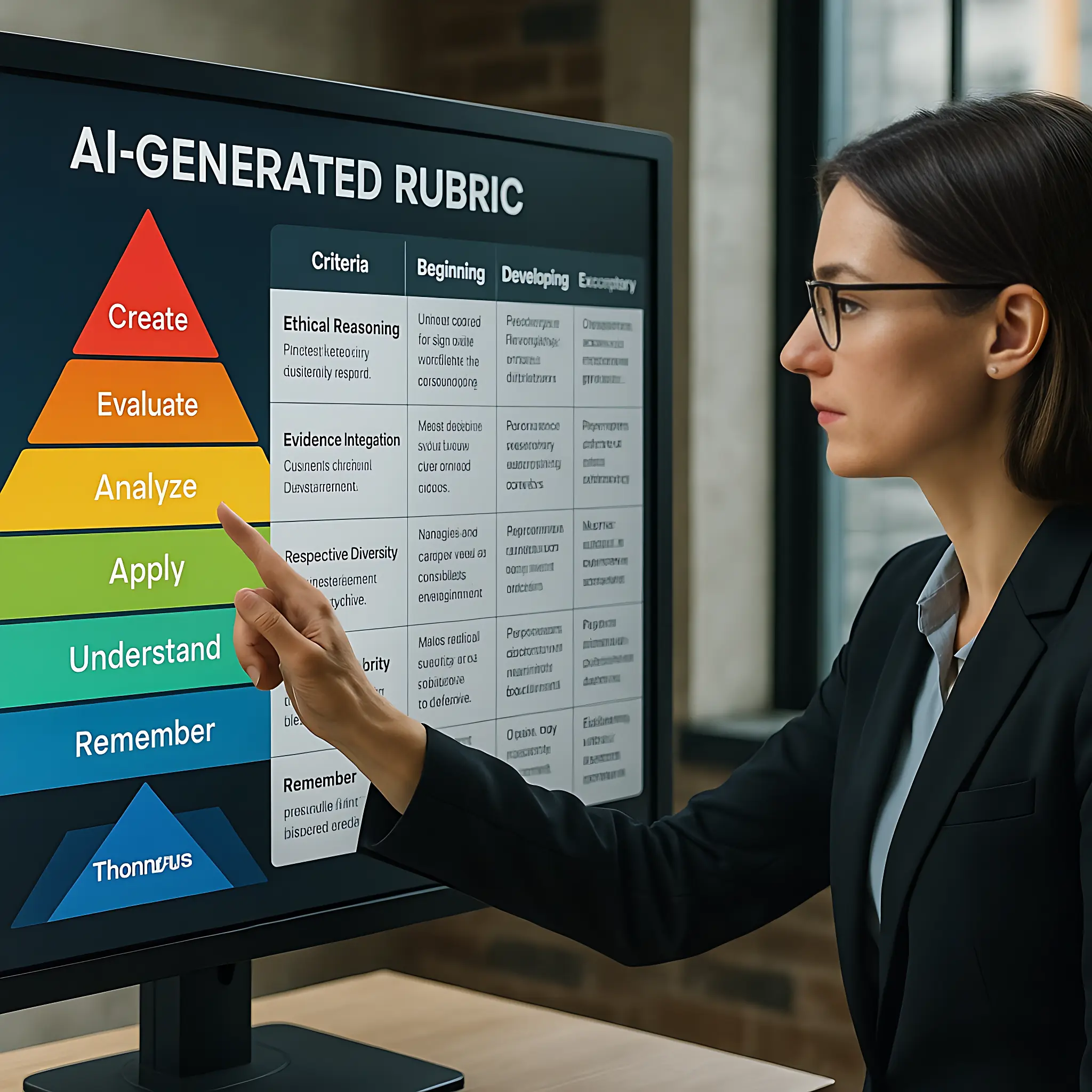
For decades, Bloom’s Taxonomy has been a foundational framework for designing educational goals, activities, and assessments. But in today’s digital-first, AI-enhanced learning environments, educators face a new challenge:
How do we align Bloom’s hierarchy with the powerful—but sometimes generic—output of AI-based rubric generators?
The rise of generative AI tools like ChatGPT, Claude, and Gemini has enabled rapid creation of marking rubrics, assessment feedback, and learning descriptors. However, without clear alignment to cognitive levels, these tools risk diluting learning standards.
In this post, we’ll explore how to integrate Bloom’s Taxonomy into AI-assisted rubric design, creating a future-ready approach to authentic, measurable, and scalable learning assessment.
Quick Recap: Bloom’s Taxonomy in 2025
Bloom’s Taxonomy remains the most widely adopted cognitive framework in both academic and corporate learning design. It provides a hierarchical model for categorising cognitive skills into six levels:
| Level | Cognitive Verb Examples |
|---|---|
| Remember | define, recall, list |
| Understand | explain, describe, classify |
| Apply | demonstrate, solve, use |
| Analyze | compare, differentiate, dissect |
| Evaluate | justify, assess, critique |
| Create | design, construct, formulate |
Each level supports increasing depth and complexity, making it crucial for designing rubrics that move learners toward higher-order thinking.
Problem: AI Rubric Tools Often Miss the Bloom Alignment
Most AI rubric generators are trained on generic templates and open-source datasets. As a result, their output may lack:
- Clear differentiation between Bloom levels
- Accurate progression of difficulty
- Appropriate verb usage for learning tasks
- Precise mapping to Learning Outcomes (LOs) and assessment standards
Without manual intervention, your AI-generated rubric might assess "Create" tasks using "Understand"-level descriptors.
Step-by-Step: Aligning Bloom’s Taxonomy with AI Rubric Generators
Here’s how to make sure your AI-assisted rubrics stay pedagogically sound:
Step 1: Define Learning Outcomes Using Bloom’s Verbs
Before using any AI tool, write specific learning outcomes with appropriate Bloom-level verbs.
Example (Corporate Leadership Course):
"Learners will be able to critically evaluate ethical leadership strategies in AI deployment."
AI input:
"Generate a rubric aligned with the learning outcome: 'Critically evaluate ethical leadership strategies…' using Bloom’s level 5: Evaluate."
This tells the AI to avoid low-level verbs like “list” or “describe.”
Step 2: Embed Bloom Level in AI Prompts
Prompt structure for GPT-4 or Claude:
“Create a 4-level analytic rubric for a task at Bloom’s level 4 (Analyze). Include four criteria: reasoning, evidence, structure, and clarity. Use verbs like compare, differentiate, dissect.”
The AI will shape descriptors around Analyze-level cognition.
Step 3: Review and Replace Misaligned Verbs
Post-generation, scan for:
- Vague verbs (e.g., “understand” in place of “apply”)
- Overlap between levels (common in ‘Apply’ vs. ‘Analyze’)
- Misused or contextually incorrect language
Use Bloom verb lists (or digital tools like Bloom’s Wheel) to replace generic AI-generated phrasing with accurate terminology.
Step 4: Layer AI Output with Cognitive Scaffolding
Rubrics that align to Bloom’s hierarchy should visually signal progression.
| Criteria | Emerging (Apply) | Proficient (Analyze) | Advanced (Evaluate) |
|---|---|---|---|
| Ethical Judgment | Uses examples of rules | Identifies ethical trade-offs | Justifies decisions with frameworks |
| AI Impact | Describes positive outcomes | Compares positive and negative | Critiques assumptions and outcomes |
AI tools can generate this table, but you must guide it to represent the hierarchy.
Step 5: Use AI Feedback Generators with Bloom-Aware Templates
When using AI to generate rubric-based feedback, prompt it to match tone and depth with the Bloom level.
Example:
“Generate formative feedback for a student who partially meets the ‘Create’ level in a leadership innovation project rubric.”
AI Feedback Sample:
“Your initiative shows originality, but the strategic planning lacks coherence. Consider revising your model to better reflect stakeholder complexity.”
This ensures feedback matches expectations.
Practical Use Case: TheCaseHQ’s AI + Bloom Model
Platform: TheCaseHQ.com
Challenge: Faculty were using ChatGPT to generate rubrics, but the outputs weren’t always Bloom-aligned, leading to superficial assessments.
Solution:
A new system was introduced:
- Faculty selected the Bloom level from a dropdown
- The AI prompt auto-included verbs and cognitive expectations
- Rubric drafts were reviewed with a Bloom-alignment checklist
Result:
Student assessment alignment improved by 40%, and faculty reported 2x faster rubric creation with higher accuracy.
Tools to Support Bloom + AI Rubric Alignment
| Tool | Functionality |
|---|---|
| ChatGPT (with prompt templates) | Dynamic rubric generation with Bloom layers |
| Bloom’s Digital Wheel | Interactive verb guide for cognitive alignment |
| Curipod AI | Bloom-aware question and rubric generation |
| iRubric AI Assistant | Automated rubric design with taxonomy filters |
| CaseHQ’s Rubric Builder | Uses AI + Bloom selection for real-world cases |
Benefits of Bloom-Aligned AI Rubrics
- Better instructional alignment
- Transparent learner expectations
- Stronger accreditation mapping (PLOs, NQFs)
- Efficient feedback cycles
- Scalable rubric creation across courses
Common Pitfalls to Avoid
- Prompting AI with vague outcomes
- Assuming AI understands progression levels
- Using generic language like “good” or “satisfactory”
- Relying solely on auto-generated content
- Ignoring feedback-level alignment to Bloom
Beyond Bloom: Future-Proofing AI Rubric Design
While Bloom’s Taxonomy remains essential, future frameworks will integrate:
- AI ethics and cognitive transparency
- Soft skill metrics (e.g., empathy, resilience)
- Machine-readable rubric standards (JSON-LD, xAPI)
- Dynamic scaffolding based on learner behaviour
Look out for Gen AI tools that learn from your prior rubrics, continuously improving alignment and depth.
Conclusion: A Human-AI Collaboration for Deeper Learning
The magic isn’t in the AI alone—it’s in the partnership between pedagogy and technology.
By embedding Bloom’s Taxonomy directly into your AI rubric design process, you can:
- Accelerate rubric development
- Maintain academic integrity
- Provide meaningful, progressive assessments
Rubrics shouldn’t just assess—they should build thinking. AI can help, but you set the standard.
Visit The Case HQ for 95+ courses
Read More:
Understanding the Importance of Case Studies in Modern Education
How to Write a Compelling Case Study: A Step-by-Step Guide
The Role of Research Publications in Shaping Business Strategies
The Impact of Real-World Scenarios in Business Education
The Power of Field Case Studies in Understanding Real-World Businesses
Compact Case Studies: The Bite-Sized Learning Revolution
Utilizing Published Sources in Case Study Research: Advantages and Pitfalls
Leveraging Case Studies for Business Strategy Development
Inspiring Innovation Through Case Studies: A Deep Dive
The Art and Science of Writing Effective Case Studies
Exploring the Role of Case Studies in Market Research
How Case Studies Foster Critical Thinking Skills
https://thecasehq.com/aligning-blooms-taxonomy-with-ai-rubric-generators/?fsp_sid=4096
Comments
Post a Comment