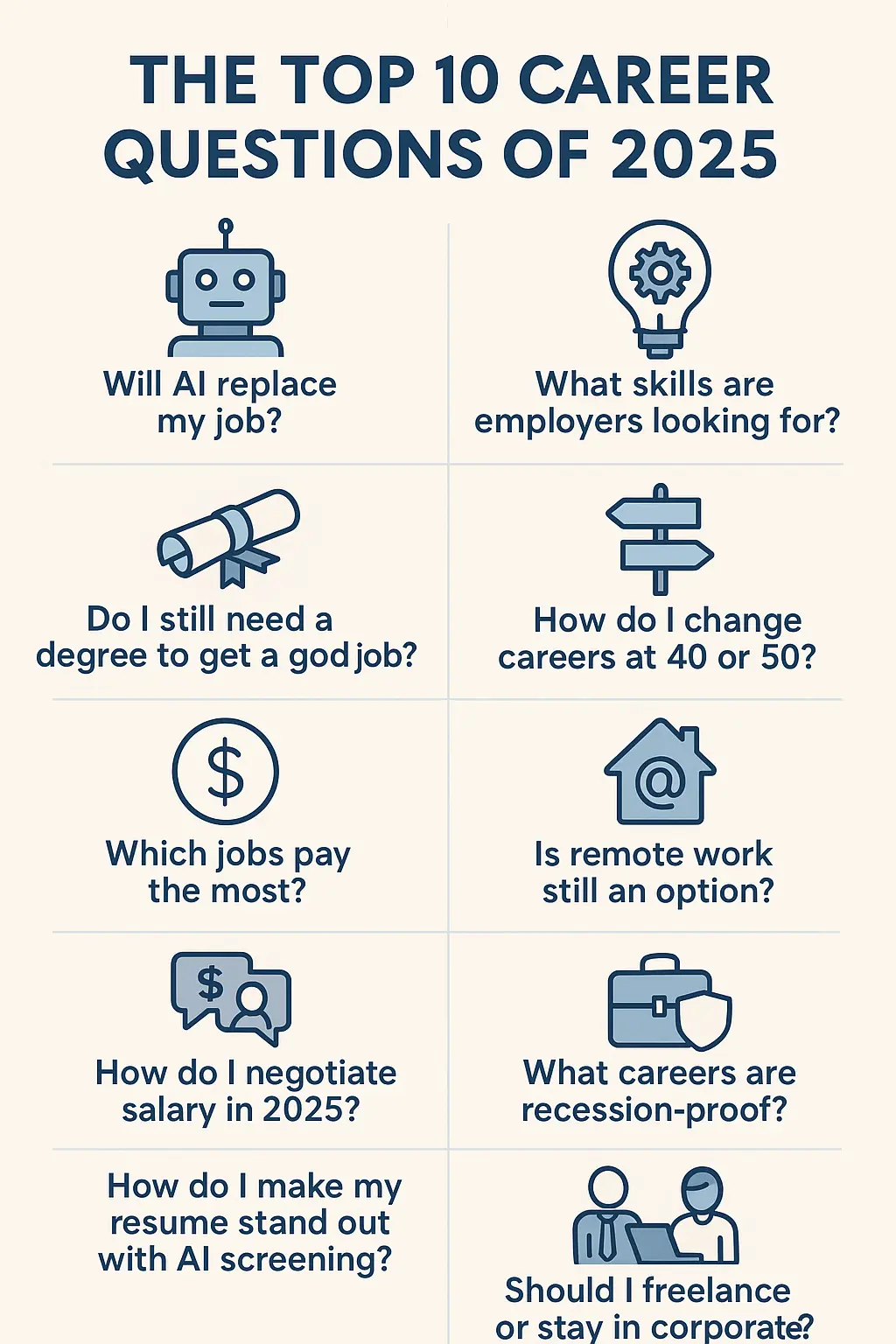
Every year, millions of professionals turn to Google for career guidance. In 2025, with AI disruption, hybrid work, and global economic shifts, people are asking more career questions than ever before. From job security to upskilling, these searches reveal what’s really on the minds of today’s workforce.
This article explores the most Googled career questions in 2025 and provides clear, practical answers to help professionals take control of their future.
Why Career Questions Are Exploding in 2025
- AI-powered disruption – Workers worry about automation replacing jobs.
- Upskilling demand – Professionals are asking how to quickly gain future-proof skills.
- Workplace transformation – Hybrid work and global mobility raise new questions.
- Career transitions – More employees are switching industries mid-career.
Search data shows that career questions are no longer just for students executives, freelancers, and mid-career professionals are Googling too.
The 10 Most Googled Career Questions in 2025 (with Answers)
1. Will AI replace my job?
AI will automate tasks, not entire professions. Roles in administration and routine data entry face the highest risk, but new opportunities are emerging in AI strategy, ethics, and integration.
Answer: Future-proof your career by learning AI-powered tools and focusing on human skills like communication, creativity, and problem-solving.
2. What skills are employers looking for in 2025?
Employers now prioritize AI fluency, data literacy, adaptability, and leadership. Soft skills like collaboration and emotional intelligence remain vital.
Answer: Blend technical upskilling with leadership training. Certifications in AI, digital transformation, or ESG boost credibility.
3. Do I still need a degree to get a good job?
Degrees still matter in some fields, but micro-credentials and certifications are beating traditional degrees in speed and relevance.
Answer: Focus on stackable skills-based learning short programs that prove immediate job readiness.
4. How do I change careers at 40 or 50?
Mid-career transitions are common in 2025. The key is transferable skills.
Answer: Use a career pivot plan:
- Audit your existing strengths
- Gain a targeted certification in your new field
- Build a portfolio to prove competence
5. Which jobs pay the most in 2025?
High-paying careers include AI product managers, data scientists, cybersecurity experts, sustainability officers, and healthcare AI specialists.
Answer: Focus on jobs that blend AI + industry knowledge, as these are the biggest salary multipliers.
6. Is remote work still an option?
Yes, but hybrid is now dominant. Employers want in-person collaboration while keeping flexibility.
Answer: Position yourself as a hybrid-ready professional who can thrive in both settings.
7. How do I negotiate salary in 2025?
Transparency laws in many countries make pay data more accessible.
Answer: Research benchmarks on Glassdoor and Levels.fyi. Use AI tools to simulate negotiation conversations before speaking with HR.
8. What careers are recession-proof?
Healthcare, cybersecurity, AI governance, education, and renewable energy are in-demand regardless of economic cycles.
Answer: Focus on sectors tied to essential services or future megatrends.
9. How do I make my resume stand out with AI screening?
AI Applicant Tracking Systems (ATS) filter resumes.
Answer: Optimize your CV with role-specific keywords, clear formatting, and evidence of AI-powered project experience.
10. Should I freelance or stay in corporate?
Both have trade-offs. Corporate offers stability; freelancing offers flexibility and control.
Answer: A rising trend in 2025 is portfolio careers blending part-time freelance with a corporate anchor.
Trends Behind the Career Questions
- AI anxiety is the #1 driver of search queries.
- Upskilling urgency shows professionals know continuous learning is non-negotiable.
- Flexibility demand highlights the importance of hybrid and portfolio careers.
Case Study: The Career Pivoter
Maria, a 42-year-old HR professional, feared AI would make her role obsolete. By completing a Certified AI Strategic HR Leader course, she transitioned into an AI governance officer role.
Her career question “How do I change careers at 40?” was answered with targeted credentials and confidence.
How to Use Career Questions to Your Advantage
- Track trends – What people Google reflects future job markets.
- Personalize answers – Don’t copy generic advice; tailor strategies to your industry.
- Act early – The earlier you prepare, the less disruptive career changes feel.
Conclusion: Asking the Right Career Questions Is the First Step
The most Googled career questions in 2025 show that people are searching for security, growth, and adaptability in a rapidly shifting world of work.
By asking and answering, the right career questions, you can stay ahead of disruption, position yourself for high-demand roles, and build resilience in the future of work.
Visit our other human resource certifications
Visit our other artificial intelligence certifications
Visit our other digital technology certifications
Visit our other higher education certifications
Visit our other quality and lean six sigma certifications
Visit our other strategy and management certifications
Read More:
Game-Changing Power of Automating Constructive Feedback Using LLMs in Education
Critical Ethical Considerations in AI-Based Testing Every Educator Must Know
How to Build a Powerful AI-Enabled Assessment Ecosystem for Future-Ready Learning
How AI Simplifies Grading and Reporting Workflows for Educators and Institutions
AI Assessment in STEM vs Humanities: Key Differences Every Educator Should Understand
Traditional vs AI-Based Assessments: A Comprehensive Comparison for Modern Educators
How Artificial Intelligence Is Revolutionizing Competency-Based Education
https://thecasehq.com/career-questions-the-most-2025/?fsp_sid=4796
Comments
Post a Comment