When you think of the skills a CEO needs decision-making, strategic vision, risk management, and people leadership you might assume they come only from years of executive experience. But there’s another powerful tool that builds these skills faster than you might expect: Case Studies.
In business schools, leadership development programs, and executive coaching, case studies are used to simulate the challenges CEOs face daily. By analyzing real-world business dilemmas and making decisions under uncertainty, you train your mind to think more strategically exactly how a CEO must operate.
Why CEOs Think Differently
CEOs don’t just manage tasks; they navigate uncertainty, make bold choices, and create long-term value. To think like a CEO, you must:
- Evaluate multiple perspectives under pressure.
- Balance short-term results with long-term vision.
- Manage risk, ambiguity, and incomplete information.
- Lead teams, stakeholders, and investors toward a shared goal.
Case studies simulate these real-world leadership challenges, forcing you to step into the CEO’s shoes.
The Power of CEO Training
- Decision-Making Under Pressure
these put you in complex scenarios market crashes, ethical dilemmas, disruptive competitors. You must decide quickly, with incomplete data, just like a CEO. - Strategic Vision
By analyzing case studies from companies like Apple, Netflix, or Toyota, you practice identifying long-term opportunities beyond the immediate crisis. - Risk Management
CEOs constantly balance bold innovation with downside risks. Case studies teach you how to evaluate risk-reward trade-offs in uncertain markets. - Stakeholder Leadership
Most case studies include multiple voices: employees, customers, investors, regulators. You learn to balance conflicting demands a core CEO skill.
How Case Studies Mimic the CEO Experience
- Ambiguity: You never get “all the data” — just like real executives.
- Tough Choices: Often, there is no single right answer. You must defend your decision.
- Leadership Practice: These discussions mirror boardroom debates, sharpening persuasion and communication skills.
- Iterative Learning: By analyzing many cases, you develop mental models that CEOs use when facing uncertainty.
This is why Harvard Business School, INSEAD, and Wharton all rely heavily on case study teaching in their executive MBA programs.
Real Examples of CEO Thinking
Example 1: Crisis Leadership
- Case: Johnson & Johnson Tylenol crisis.
- Lesson: Acting decisively on values (product recall) can save brand reputation long-term.
Example 2: Strategic Innovation
- Case: Netflix’s pivot from DVDs to streaming.
- Lesson: CEOs must anticipate disruption and re-invent business models.
Example 3: Global Expansion
- Case: Starbucks entry into China.
- Lesson: Adapting business models to cultural context is a hallmark of strategic leadership.
Each of these cases forces you to grapple with the same dilemmas CEOs faced making case studies a direct simulation of leadership at the top.
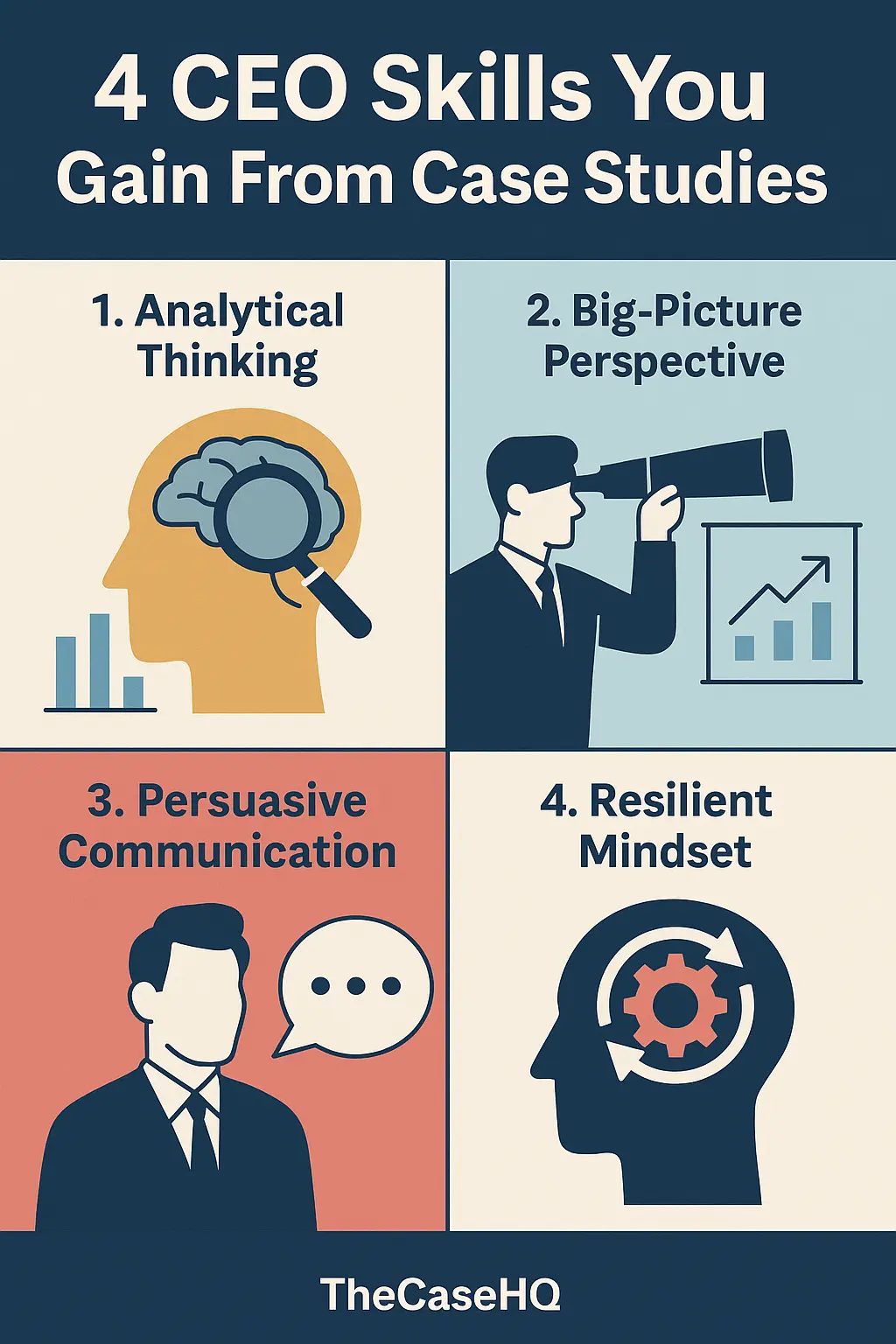
The 4 CEO Skills You Gain From Case Studies
- Analytical Thinking – Spotting hidden insights in data.
- Big-Picture Perspective – Seeing long-term trends beyond day-to-day operations.
- Persuasive Communication – Defending and selling your decisions.
- Resilient Mindset – Learning that failure and iteration are part of leadership.
How You Can Use Case Studies to Train Yourself
- Read Widely Across Industries
Don’t limit yourself to tech. Study healthcare, retail, energy, and non-profits. CEOs must understand multiple landscapes. - Engage in Group Discussions
Case studies are most powerful when debated. Find peers, LinkedIn groups, or online forums to sharpen your arguments. - Apply to Your Own Context
After analyzing a case, ask: How would I use this insight in my company or career? - Document Your Learning
Keep a portfolio of case studies you’ve analyzed and the decisions you made. This shows potential employers your CEO-style thinking.
Why Employers Value Case Study Skills
When you mention case study learning in interviews, you demonstrate:
- Problem-solving ability under real-world conditions.
- Leadership mindset — the ability to weigh risks and opportunities.
- Communication skills from presenting and debating cases.
For professionals aiming at AI-powered jobs, consulting roles, or leadership tracks, showcasing case study analysis sets you apart as a strategic thinker.
Conclusion: Case Studies Are CEO Training in Disguise
To think like a CEO, you don’t need the title or years of boardroom experience. You need to practice making tough decisions, balancing risk, and communicating vision under pressure.
That’s exactly what case studies train you to do. By regularly analyzing case-based scenarios, you develop the strategic mindset that leaders at the highest level rely on every day.
Start building your leadership edge now. Explore case-based programs at TheCaseHQ and accelerate your journey to CEO-level thinking.
Visit our other human resource certifications
Visit our other artificial intelligence certifications
Visit our other digital technology certifications
Visit our other higher education certifications
Visit our other quality and lean six sigma certifications
Visit our other strategy and management certifications
Read More:
The Art of Crafting Compelling Case Studies: Tips for Success
How to Use Case Studies to Showcase Your Expertise
A Step-by-Step Guide to Writing Impactful Business Case Studies
The Role of Case Studies in Academic Research: Best Practices
Case Study Writing: Turning Real-World Scenarios into Educational Tools
https://thecasehq.com/case-studies-train-you-like-a-ceo/?fsp_sid=4572
Comments
Post a Comment