In 2025, Case vs Project-Based Learning education is undergoing a rapid transformation. Universities, business schools, and training programs are no longer debating whether to use active learning, the question now is which method delivers the best results: Case-Based Learning (CBL) or Project-Based Learning (PBL).
Both approaches prepare learners for the real world, but in different ways. This article explores Case vs Project-Based Learning in 2025, comparing their strengths, weaknesses, and practical applications across industries.
Understanding Case vs Project-Based Learning
Case-Based Learning (CBL)
- Uses real or simulated case studies to spark discussion.
- Students analyze a scenario, debate possible solutions, and defend their decisions.
- Widely used in business schools, law, and medicine.
Project-Based Learning (PBL)
- Involves long-term projects where students create tangible solutions.
- Requires research, collaboration, and iterative problem-solving.
- Popular in engineering, design, education, and STEM programs.
While both focus on applied learning, CBL sharpens decision-making while PBL builds execution skills.
Why Case-Based Learning Works in 2025
- Decision-Making Under Uncertainty
Cases replicate the ambiguity leaders face in the real world. Learners practice making choices without full data. - Critical Thinking
By analyzing cases from companies like Netflix, Tesla, or NGOs, students learn to evaluate trade-offs. - Communication Skills
CBL requires learners to present, defend, and persuade, mirroring executive boardroom discussions. - Transferability
A single case can be applied across industries, giving students broad exposure to strategic thinking.
Best suited for: Business, healthcare, law, policy, management.
Why Project-Based Learning Works in 2025
- Hands-On Application
PBL emphasizes building solutions, not just discussing them. - Collaboration & Teamwork
Students work in teams, learning how to coordinate roles, manage conflicts, and deliver outcomes. - Creativity & Innovation
Projects allow for design thinking, prototyping, and experimentation. - Portfolio Building
Graduates leave with real deliverables apps, reports, models that employers value.
Best suited for: Engineering, design, education, sustainability projects.
Case vs Project-Based Learning: A Side-by-Side Comparison
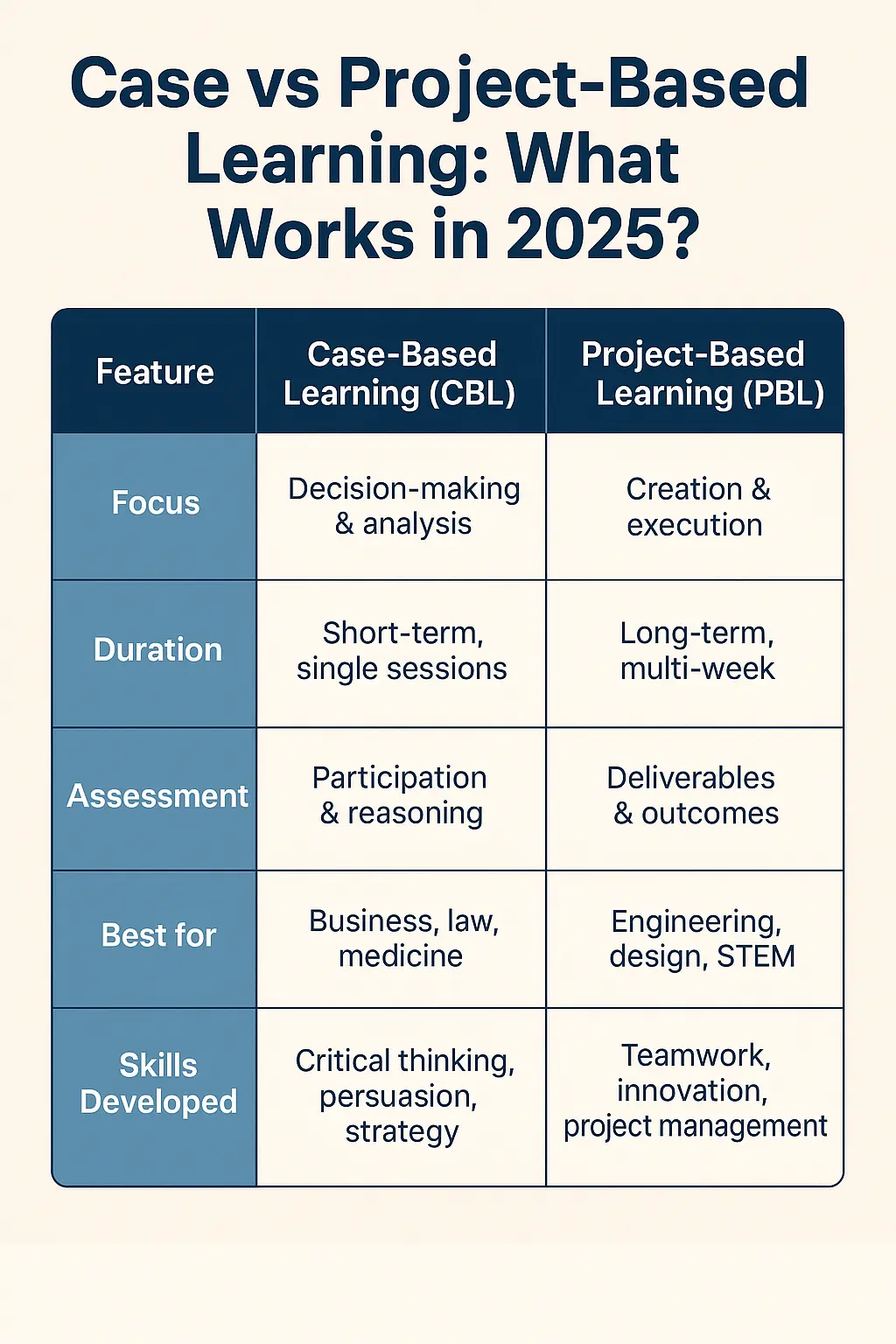
| Feature | Case-Based Learning (CBL) | Project-Based Learning (PBL) |
|---|---|---|
| Focus | Decision-making & analysis | Creation & execution |
| Duration | Short-term, single sessions | Long-term, multi-week |
| Assessment | Participation & reasoning | Deliverables & outcomes |
| Best for | Business, law, medicine | Engineering, design, STEM |
| Skills Developed | Critical thinking, persuasion, strategy | Teamwork, innovation, project management |
Real-World Examples
- Harvard Business School (CBL): Uses 500+ cases annually to prepare leaders for uncertainty.
- MIT Engineering (PBL): Requires students to complete real-world projects with industry sponsors.
- Healthcare (Hybrid): Medical schools combine case discussions (diagnosis) with projects (designing treatment plans).
The 2025 Twist: Hybrid Models
Educators are no longer asking “Case vs Project-Based Learning” they’re blending both.
- Hybrid Example 1: Students analyze a case (CBL), then execute a related project (PBL).
- Hybrid Example 2: Corporate training mixes case discussions with real-time simulations.
- Hybrid Example 3: Online learning platforms use AI to generate adaptive case studies followed by mini-projects for application.
In 2025, the most effective learning combines analysis with execution.
What Employers Say
A 2025 survey of 500 global employers found:
- 72% value case-based learning for decision-making and leadership readiness.
- 81% value project-based learning for practical skills and innovation.
- 64% believe hybrid models best prepare graduates for modern workplaces.
How Students Can Choose Between Case vs Project-Based Learning
- If you want to become a strategist, consultant, or executive → prioritize CBL.
- If you want to design, build, or innovate → focus on PBL.
- If you want to lead in fast-changing industries → combine both.
Conclusion: What Works Best in 2025-Case vs Project-Based Learning?
The debate over Case vs Project-Based Learning isn’t about picking a winner. In 2025, the real power lies in combination.
- CBL sharpens critical thinking and decision-making.
- PBL builds creativity, collaboration, and execution.
The most successful learners and institutions in 2025 blend case-based insights with project-based outcomes, producing graduates who can think like strategists and act like innovators.
Visit our other human resource certifications
Visit our other artificial intelligence certifications
Visit our other digital technology certifications
Visit our other higher education certifications
Visit our other quality and lean six sigma certifications
Visit our other strategy and management certifications
Read More:
The Future of Learning and Assessment: Redefining Education for an AI-Driven Era
Designing the Future Faculty: A Practical Guide to Academic and Faculty Development
Mastering Case Study Writing and Teaching: A Practical Guide for Business Educators
The Future of Education: AI and Digital Transformation in the Classroom
Gamification in Education: Beyond Points and Badges – Strategies That Truly Engage
High-Impact Blended Learning Models That Work in 2025
Step-by-Step Guide: Backward Design in Course Planning for Effective Teaching
From Traditional to Transformative: The Evolution of Pedagogy in Modern Education
https://thecasehq.com/case-vs-project-based-learning/?fsp_sid=4764
Comments
Post a Comment