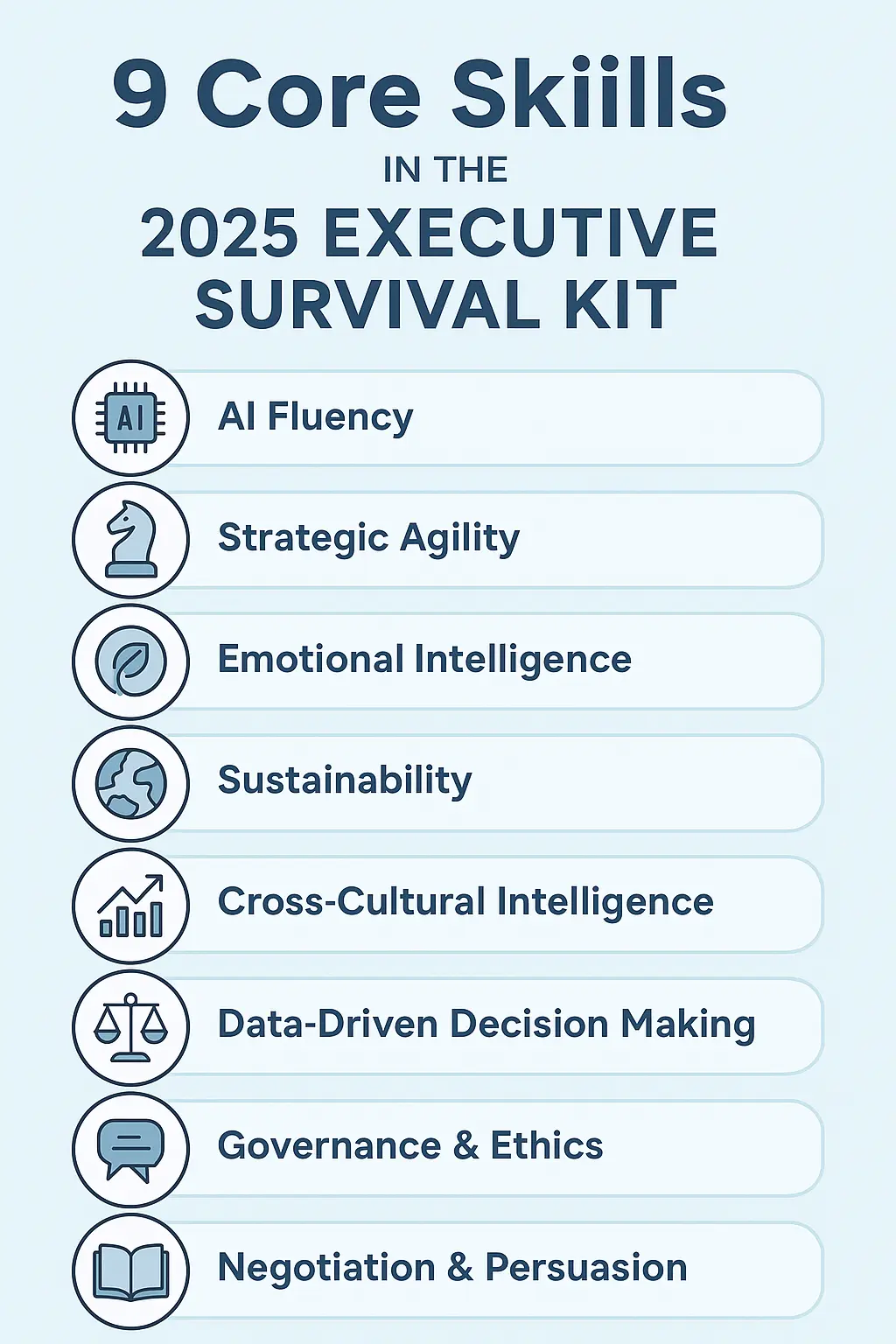
The business world in 2025 is moving at breakneck speed. Technology, markets, and workforce expectations are evolving so rapidly that executives who fail to adapt risk becoming obsolete. That’s why more leaders are now investing in an Executive Survival Kit, a set of essential skills, tools, and mindsets required to stay relevant and resilient in today’s environment.
This article unpacks what belongs in the 2025 Executive Survival Kit, highlighting the critical areas of learning every senior leader should prioritize before it’s too late.
Why an Executive Survival Kit Is Essential in 2025
Executives are facing unprecedented challenges:
- AI disruption – Artificial intelligence is reshaping every industry.
- Geopolitical volatility – Leaders must navigate instability in supply chains and regulations.
- Workforce transformation – Hybrid work, Gen Z values, and DEI expectations redefine leadership.
- Sustainability pressure – ESG compliance and stakeholder demands are non-negotiable.
Without a structured Executive Survival Kit, leaders risk falling behind faster-moving competitors.
What to Include in the 2025 Executive Survival Kit
1. AI Fluency & Digital Transformation Skills
Executives don’t need to code, but they must understand how AI and digital transformation impact strategy.
Learn before it’s too late:
- How AI tools enhance decision-making
- Governance frameworks like ISO/IEC 42001
- Practical use cases in finance, HR, marketing, and operations
AI is no longer optional. In 2025, AI literacy is the foundation of any Executive Survival Kit.
2. Strategic Agility & Scenario Planning
Leaders must adapt to fast-changing conditions. Scenario planning prepares executives for multiple futures instead of betting on one.
Learn before it’s too late:
- Scenario mapping techniques
- Risk management with AI-driven simulations
- Pivot strategies during market disruption
3. Emotional Intelligence & Human-Centered Leadership
Amid automation, the human factor is what sets great executives apart. Emotional intelligence (EQ) drives trust, motivation, and resilience.
Learn before it’s too late:
- Coaching conversations with employees
- Managing hybrid and global teams
- Empathy in decision-making
EQ remains a cornerstone of the Executive Survival Kit because machines can’t replace human leadership.
4. Sustainability & ESG Competence
Investors, regulators, and employees all demand sustainable practices. Executives must align business models with environmental and social responsibility.
Learn before it’s too late:
- ESG reporting frameworks (GRI, SASB, TCFD)
- Carbon reduction strategies
- Linking sustainability with profitability
5. Cross-Cultural Intelligence
Globalization requires leaders to navigate diverse cultural expectations.
Learn before it’s too late:
- Cross-cultural negotiation tactics
- Inclusive communication for global teams
- Understanding geopolitical dynamics in business deals
6. Data-Driven Decision Making
The best executives in 2025 don’t rely only on intuition, they combine gut instinct with analytics.
Learn before it’s too late:
- Data visualization with tools like Power BI
- Predictive analytics for strategic planning
- Distinguishing between correlation and causation
7. Governance, Risk & Ethics in AI
AI is bringing new compliance challenges. Boards now expect executives to lead in responsible AI adoption.
Learn before it’s too late:
- The EU AI Act and global regulations
- AI bias and fairness audits
- Building ethical governance frameworks
No Executive Survival Kit is complete without ethics training for AI adoption.
8. Negotiation & Persuasion Mastery
Whether dealing with investors, regulators, or talent, persuasion is a CEO-level skill.
Learn before it’s too late:
- Advanced negotiation strategies
- Storytelling with data
- Influence tactics in boardroom dynamics
9. Continuous Learning & Growth Mindset
Executives who stop learning are quickly replaced by those who adapt. In 2025, the half-life of skills is less than 3 years.
Learn before it’s too late:
- Lifelong learning strategies
- Executive coaching and peer learning groups
- Leveraging micro-credentials to stay relevant
Real-World Example: The Unprepared vs The Prepared Executive
- Unprepared: A senior retail executive ignored AI-driven e-commerce disruption. Within 2 years, competitors overtook their market share.
- Prepared: Another executive invested in AI fluency, sustainability certifications, and scenario planning. They pivoted early to omnichannel retail and secured investor confidence.
The difference? One built an Executive Survival Kit, the other did not.
How to Build Your Executive Survival Kit in Practice
- Audit your skills – Identify gaps against the 9 categories above.
- Prioritize short courses – Certifications like Certified AI Business Strategist provide rapid upskilling.
- Build a peer network – Share insights with other executives.
- Document your learning – Keep a personal “Executive Playbook” with strategies, templates, and lessons.
Conclusion: Don’t Wait Until It’s Too Late
The Executive Survival Kit is not just a metaphor — it’s a reality for leaders in 2025. The world is moving faster than ever, and only those who continuously learn and adapt will thrive.
If you want to stay ahead, start building your Executive Survival Kit today: focus on AI fluency, strategic agility, emotional intelligence, sustainability, and governance.
By investing in these skills now, you won’t just survive the future of work — you’ll shape it.
Visit The Case HQ for 95+ courses
Visit our other human resource certifications
Visit our other artificial intelligence certifications
Visit our other digital technology certifications
Visit our other higher education certifications
Visit our other quality and lean six sigma certifications
Visit our other strategy and management certifications
Read More:
Powerful Strategies for Creating AI-Enhanced Assessment Rubrics in Modern Education
Smart Guide: How to Choose a PhD Research Topic That Stands Out
What No One Tells You About Starting a PhD—Essential Truths You Need to Know
Groundbreaking or Overhyped: Is Gen AI the Most Important Innovation Since the Printing Press?
Smart Strategies for Conducting a Literature Review using AI Tools
Innovative Strategies: How Universities Integrate ChatGPT Into Its Curriculum
https://thecasehq.com/executive-survival-kit-2025/?fsp_sid=4636
Comments
Post a Comment