In 2025, the higher education landscape is undergoing a seismic shift. For decades, a university degree was considered the golden ticket to career success. But today, professionals and employers alike are increasingly favoring Micro-Credentials short, targeted, skill-focused programs over lengthy, expensive traditional degrees.
This article explores why Micro-Credentials are beating traditional degrees, what makes them so appealing to both learners and employers, and how you can leverage them to future-proof your career.
What Are Micro-Credentials?
Micro-Credentials are compact, specialized learning programs that certify mastery of a specific skill or competency. Unlike traditional degrees that take years to complete, these programs typically last from a few days to a few months.
- Examples: AI Prompt Engineering, Lean Six Sigma, Digital Marketing Analytics, AI Ethics.
- Format: Often online, flexible, and self-paced.
- Recognition: Endorsed by professional bodies, employers, or educational institutions.
Micro-Credentials are designed for speed, relevance, and direct application in the workplace.
Why Micro-Credentials Are Beating Traditional Degrees
1. Speed and Flexibility
- Traditional degrees take 3–4 years.
- Micro-Credentials can be completed in weeks or months.
Busy professionals prefer faster upskilling options that fit around work schedules rather than pausing careers for full-time study.
2. Cost-Effectiveness
- Degrees can cost anywhere from $30,000–$100,000.
- Micro-Credentials often range from $200 to $2,000.
Learners save money while still gaining credentials that employers recognize.
3. Direct Relevance to Jobs
Employers don’t just want “general knowledge” — they want applied, job-ready skills.
Micro-Credentials are laser-focused on what matters now: AI fluency, ESG reporting, data visualization, agile project management.
Instead of theoretical lectures, they emphasize practical projects and case studies that demonstrate real-world outcomes.
4. Employer Demand
LinkedIn’s 2025 Future of Work Report shows that 68% of employers value skills-based certifications as much or more than traditional degrees.
Why? Because Micro-Credentials prove immediate readiness to apply skills in the workplace.
5. Stackability and Lifelong Learning
Unlike a one-time degree, Micro-Credentials can be stacked. You can earn multiple badges or certificates across industries, tailoring your learning portfolio to evolving career goals.
Think of them as “career currency” that you can keep adding to throughout your professional journey.
6. Accessibility and Inclusivity
Micro-Credentials open the door for professionals who:
- Can’t afford full-time degrees.
- Need to pivot careers quickly.
- Live in regions where higher education access is limited.
This makes them more inclusive and democratized than traditional degrees.
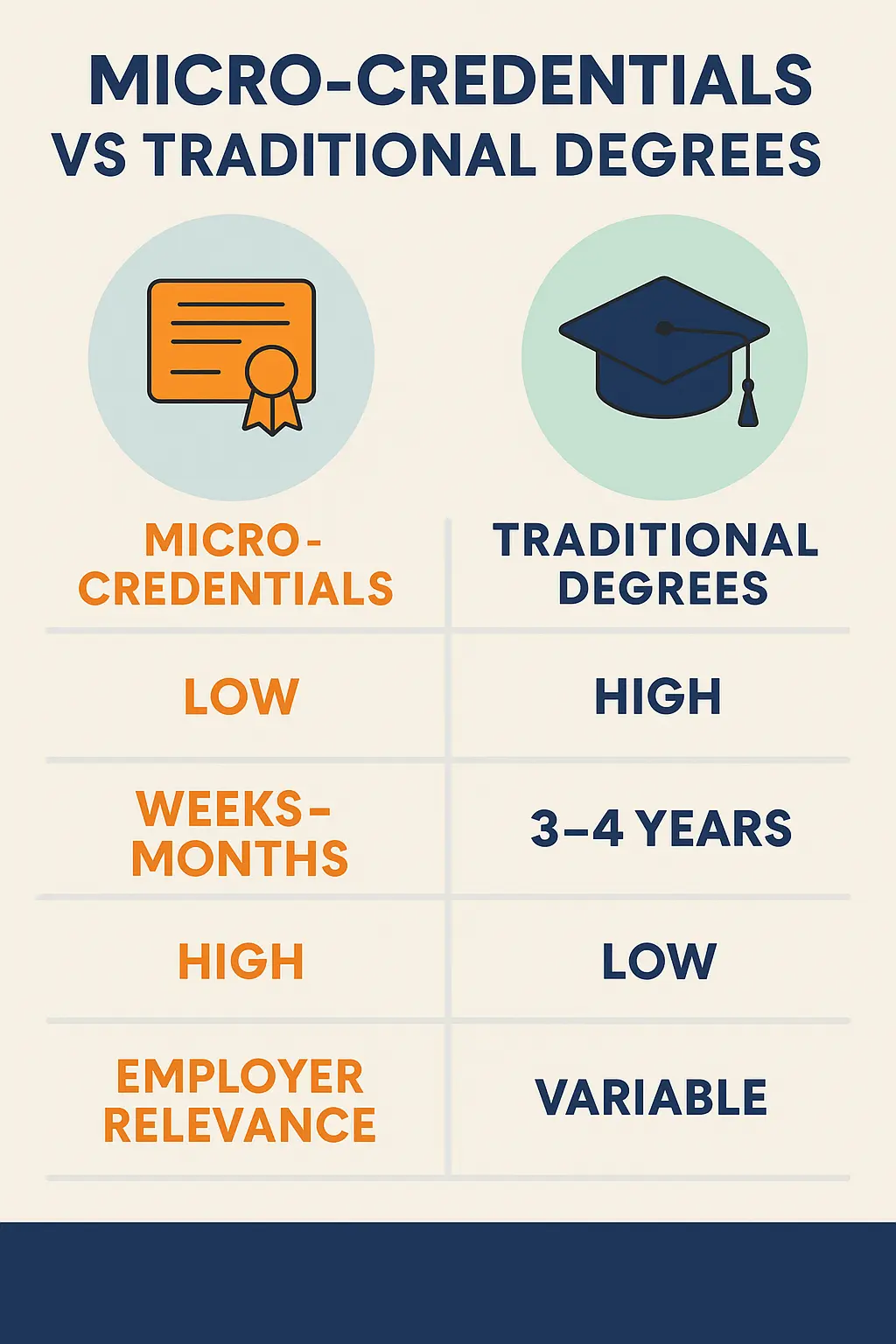
Micro-Credentials vs Traditional Degrees: A Side-by-Side
| Feature | Micro-Credentials | Traditional Degrees |
|---|---|---|
| Duration | Weeks–Months | 3–4 years |
| Cost | Low | High |
| Focus | Skills-based | Broad knowledge |
| Employer Relevance | Immediate | Variable |
| Flexibility | High | Low |
| Stackability | Yes | No |
The table makes clear why Micro-Credentials are rapidly overtaking traditional degrees in appeal.
Real-World Examples
- Tech Sector: Employers now hire AI trainers or data analysts with AI and analytics instead of requiring computer science degrees.
- Healthcare: Nurses gain specialized AI healthcare tools to stay relevant in a digitized system.
- Business Consulting: Professionals showcase Micro-Credentials in ESG and digital transformation to win client trust.
How Professionals Use to Get Ahead
- Career Pivoting – Moving from marketing to AI strategy through targeted credentials.
- Skill Refresh – Updating existing expertise (e.g., finance leaders adding data science Micro-Credentials).
- Promotion Leverage – Proving readiness for leadership roles with certifications in change management or AI governance.
The Risks of Ignoring
Executives warn that those who rely solely on traditional degrees risk:
- Becoming obsolete as skills expire faster.
- Missing opportunities for promotion.
- Losing out to peers with fresh, stackable credentials.
How to Choose the Right Ones
- Relevance: Does it target skills needed in your role/industry?
- Credibility: Is it offered by a recognized provider or professional body?
- Practical Output: Does it include real projects, case studies, or portfolio evidence?
- Stackability: Can you build on it with future learning?
High-quality programs like the Certified AI Business Strategist show employers both relevance and credibility.
Conclusion
In 2025, it’s clear that Micro-Credentials are beating traditional degrees for professionals who want speed, flexibility, and immediate workplace relevance.
They are not a replacement for all degrees, but for most career tracks, Micro-Credentials deliver more value, faster returns, and continuous adaptability.
To future-proof your career, start stacking Micro-Credentials today — and show employers you’re ready for the evolving world of work.
Visit our other human resource certifications
Visit our other artificial intelligence certifications
Visit our other digital technology certifications
Visit our other higher education certifications
Visit our other quality and lean six sigma certifications
Visit our other strategy and management certifications
Read More:
Powerful Guide to Writing Exam Questions Using Gen AI Effectively
Time-Saving Power of Using ChatGPT to Generate Lesson Plans in Minutes
Essential Guide: What Is Generative AI and Why Should Educators Care?
Innovative Ways Art & Design Schools Use AI for Portfolio Assessments
Transformative Power of AI for Assessment Dashboards and Performance Reports
Top-Rated AI Assessment Tools for Schools and Universities in 2025
Urgent Need for Addressing Bias in AI-Powered Assessment Tools
Remarkable Ways AI Can Deliver Immediate, Personalised Feedback in Education
https://thecasehq.com/micro-credentials-are-beating-traditional-degrees/?fsp_sid=4700
Comments
Post a Comment