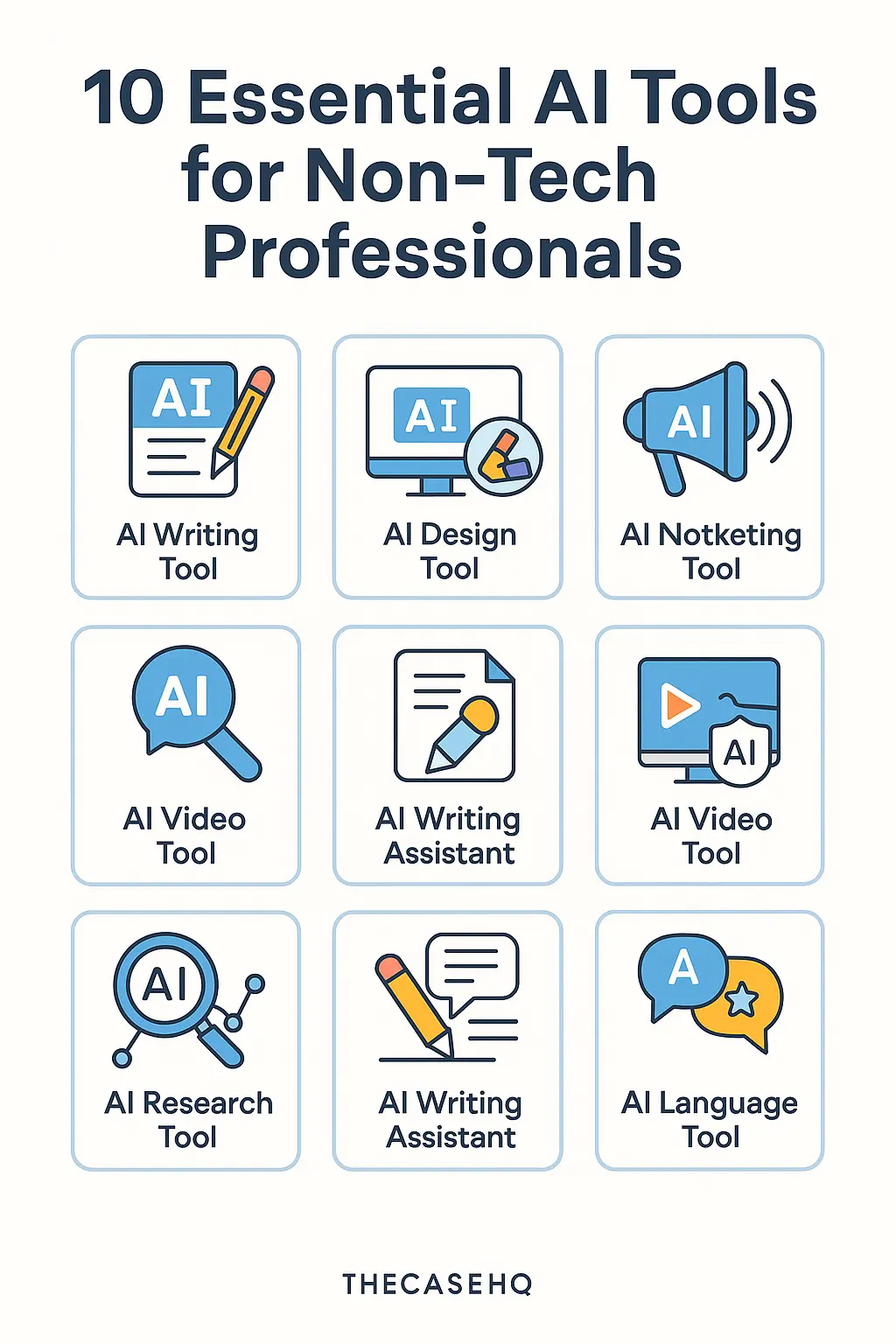
In 2025, artificial intelligence is no longer just the domain of data scientists and software engineers. From HR managers to marketers, healthcare administrators to educators, professionals in every industry are learning how to use AI to enhance productivity and decision-making. The good news? You don’t need a computer science degree to benefit.
This guide breaks down AI for Non-Tech Professionals, showing you what it is, how it’s used, and the essential tools to get started.
Why AI for Non-Tech Professionals Matters in 2025
- Democratization of AI – No-code tools and platforms now make AI accessible to everyone.
- Workplace demand – Employers want employees who can leverage AI for practical outcomes.
- Future-proofing – AI literacy is becoming as important as digital literacy.
- Competitive edge – Knowing AI helps non-technical professionals stay relevant in a fast-changing job market.
Simply put, understanding AI for Non-Tech Professionals is no longer optional, it’s a career necessity.
What Does AI Mean for Non-Tech Professionals?
Artificial Intelligence for non-technical roles means using AI as a tool, not building it. Instead of coding algorithms, you’ll:
- Apply AI tools to your daily workflow.
- Interpret AI-generated insights.
- Manage projects involving AI adoption.
- Ensure ethical and responsible use of AI.
Think of AI as a co-pilot that helps you work smarter, faster, and with more impact.
The Benefits of AI for Non-Tech Professionals
- Time Savings – Automate repetitive tasks like scheduling, reporting, or content drafting.
- Better Decisions – Use AI insights to make data-driven choices.
- Enhanced Creativity – Tools like Canva AI and Midjourney support idea generation.
- Improved Communication – AI writing assistants refine emails, reports, and presentations.
- Career Growth – Demonstrating AI fluency can lead to promotions and leadership roles.
10 Practical AI Tools for Non-Tech Professionals
1. ChatGPT / Claude
For brainstorming, drafting reports, and generating presentations.
2. Canva AI
For quickly creating visuals, infographics, and social media posts.
3. Jasper AI
For marketing copy, blog posts, and advertising campaigns.
4. Notion AI
For meeting notes, project management, and knowledge organization.
5. Synthesia
For creating professional training and explainer videos without cameras.
6. Perplexity AI
For research with citations and verified sources.
7. Power BI with AI Insights
For data visualization and trend analysis.
8. GrammarlyGO
For real-time writing and tone adjustments.
9. Duolingo Max
For AI-driven language learning and communication skills.
10. Otter.ai
For transcribing, summarizing, and extracting insights from meetings.
These tools make AI for Non-Tech Professionals practical and hands-on.
Case Studies: AI in Action for Non-Tech Professionals
- Marketing: A social media manager uses Jasper and Canva AI to launch campaigns, cutting content creation time in half.
- Human Resources: An HR officer uses AI resume parsers and Otter.ai to streamline recruitment and meeting documentation.
- Healthcare: An administrator uses AI scheduling and predictive analytics to improve patient flow.
- Education: A teacher uses ChatGPT to design adaptive lesson plans tailored to student needs.
Common Myths About AI for Non-Tech Professionals
- Myth 1: “I need coding skills to use AI.”
Reality: No-code platforms handle the technical part. - Myth 2: “AI will take my job.”
Reality: AI replaces tasks, not entire professions. - Myth 3: “AI is too expensive for individuals.”
Reality: Many AI tools are free or affordable on subscriptions.
How to Learn AI for Non-Tech Professionals
- Start Small – Experiment with free versions of AI tools.
- Take Certifications – Programs like the Certified AI Business Strategist give credibility.
- Join Communities – Engage with LinkedIn groups or professional networks.
- Document Your Learning – Create a portfolio of AI use cases relevant to your role.
Pitfalls to Avoid
- Over-relying on AI output without human judgment.
- Using AI without checking for bias or ethical concerns.
- Treating AI as a “magic fix” instead of a tool requiring strategy.
The Future of AI for Non-Tech Professionals
By 2030, AI literacy will be as essential as Microsoft Office skills are today. Employers won’t just ask if you can use AI, they’ll expect you to show how you’ve applied it to improve outcomes.
Professionals who adopt AI now will be tomorrow’s leaders.
Conclusion: Your Beginner’s Guide Starts Now
The rise of AI for Non-Tech Professionals shows that you don’t need to code to succeed in the AI-driven world. What matters is knowing how to use AI tools effectively, align them with your role, and demonstrate measurable impact.
Start today: experiment with AI platforms, build small case studies, and invest in certifications. The earlier you adopt, the stronger your career resilience will be.
Visit our other human resource certifications
Visit our other artificial intelligence certifications
Visit our other digital technology certifications
Visit our other higher education certifications
Visit our other quality and lean six sigma certifications
Visit our other strategy and management certifications
Read More:
What Is CAIBS? Discover the Certified AI Business Strategist Program Driving the Future of Work
Certified AI Business Strategist (CAIBS): A Complete Guide to AI Strategy Certification
Inside the CAIBS Course: What You’ll Learn in the Certified AI Business Strategist Program
Why CAIBS Is the #1 Choice for AI Business Professionals in 2025
Certified AI Business Strategist (CAIBS): Career ROI That Pays Off Fast
https://thecasehq.com/ai-for-non-tech-professionals-in-2025/?fsp_sid=4860
Comments
Post a Comment