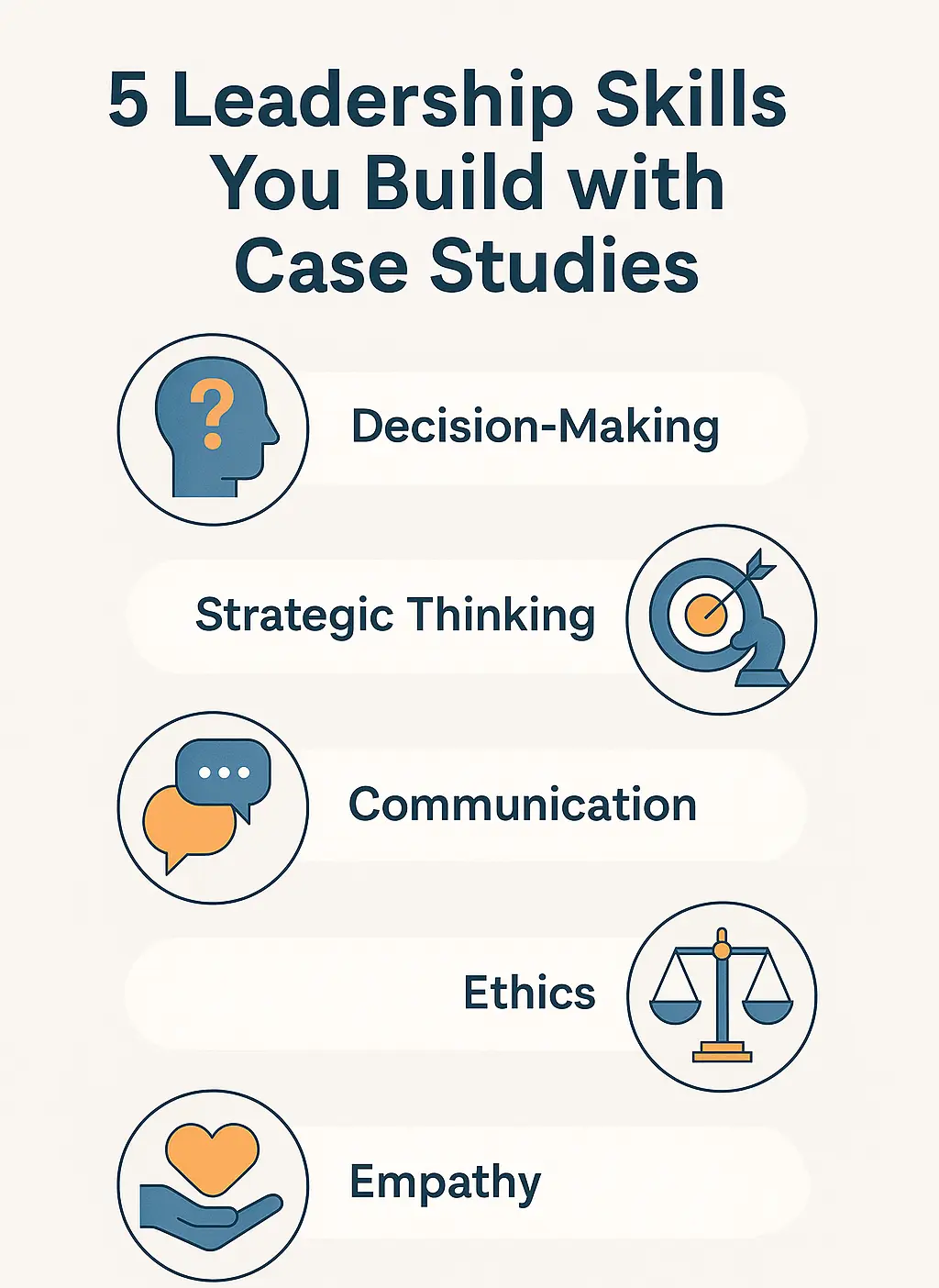
Leadership in 2025 demands more than charisma or experience. Today’s leaders face unprecedented complexity, artificial intelligence, hybrid workforces, global competition, and rising expectations for ethical decision-making. Traditional leadership training alone is no longer enough. This is why educators and executives are asking: Can Case Studies Make You a Better Leader?
The answer, increasingly, is yes. Case studies are not just academic exercises; they are powerful tools for sharpening judgment, building empathy, and practicing decision-making in uncertain conditions.
Why Ask “Can Case Studies Make You a Better Leader?”
- Leadership challenges are ambiguous — real-world problems don’t come with clear right or wrong answers.
- Experience is limited — no leader can live through every scenario, but case studies allow exposure to hundreds.
- Safe practice matters — leaders can experiment with decisions in case discussions without real-world risk.
Case studies compress years of leadership lessons into hours of analysis, reflection, and debate. Can Case Studies Make You a Better Leader
How Case Studies Build Leadership Skills
1. Decision-Making Under Pressure
Case studies force leaders to make calls with incomplete or conflicting data, just like in the real world. This sharpens analytical ability and confidence.
2. Strategic Thinking
Complex cases (e.g., corporate turnaround, AI adoption, sustainability dilemmas) require leaders to balance short-term and long-term trade-offs.
3. Communication & Persuasion
Discussing cases in groups trains leaders to articulate reasoning, defend ideas, and influence others.
4. Ethical Reasoning
Many leadership cases introduce dilemmas where profits conflict with values. Leaders must practice weighing consequences through an ethical lens.
5. Empathy & Perspective-Taking
By stepping into the shoes of a CEO, entrepreneur, or public official, case learners develop empathy and broaden their worldview.
Can Case Studies Make You a Better Leader?
Case Study Example 1: Navigating AI Disruption
A multinational bank faces staff resistance as it introduces AI-driven automation.
- Leadership challenge: Balancing cost-cutting with employee morale.
- Leadership takeaway: Leaders who applied empathy while driving innovation were most effective.
Case Study Example 2: Crisis Communication
A global airline faces a cybersecurity breach.
- Leadership challenge: Containing reputational damage while ensuring transparency.
- Leadership takeaway: Clear, authentic communication built trust faster than defensive messaging.
Case Study Example 3: Sustainability Dilemma
A manufacturing firm must decide whether to invest in costly but eco-friendly production.
- Leadership challenge: Balancing shareholder pressure with ESG commitments.
- Leadership takeaway: Leaders who framed sustainability as long-term value creation won broader support.
Can Case Studies Make You a Better Leader in Different Contexts?
- Business Schools: Harvard, INSEAD, and others use thousands of cases to develop strategic leadership skills.
- Corporate Training: Companies use case simulations to prepare executives for promotion.
- Public Policy: Governments use policy case workshops to train leaders in crisis management.
- Entrepreneurship: Startups use founder case stories to train resilience and adaptability.
The Unique Benefits of Case Study Leadership Training
- Scalability – Dozens of learners can analyze the same leadership dilemma together.
- Reflection – Cases encourage introspection: “What would I have done differently?”
- Transferability – Lessons from one case often apply across industries.
- Relevance – New cases are written on AI ethics, digital transformation, and diversity challenges, keeping training current.
How Leaders Can Use Case Studies Personally
- Self-Study: Read and reflect on leadership cases from business schools.
- Peer Learning: Form groups to debate real-world leadership challenges.
- Simulation: Use digital platforms that blend case method with AI-generated scenarios.
- Mentorship: Pair case study discussions with guidance from senior leaders.
Can Case Studies Make You a Better Leader?
Case Studies vs Other Leadership Training Methods
| Method | Strengths | Limitations |
|---|---|---|
| Case Studies | Builds judgment, strategic thinking, empathy | Requires active engagement |
| Workshops | Skill-focused, interactive | Narrow scope, often scripted |
| Lectures | Provide knowledge and frameworks | Passive, limited application |
| Mentorship | Real-world guidance | Dependent on mentor availability |
The best leadership programs blend case studies with mentorship and hands-on projects. Can Case Studies Make You a Better Leader?
What Employers Say
- 78% of executives believe case-based learning improved leadership readiness in corporate programs (2025 survey).
- 65% prefer candidates who have engaged in case-based or project-based problem solving.
- Employers value judgment under ambiguity more than technical mastery.
Can Case Studies Make You a Better Leader?
Conclusion: The Leadership Advantage of Case Studies
So, Can Case Studies Make You a Better Leader?
Absolutely, they provide a laboratory for leadership, where individuals can practice strategy, ethics, and communication in a safe but challenging environment.
In 2025 and beyond, leaders who engage with case studies won’t just read about leadership, they’ll live it, debate it, and refine it before applying it in the real world.
If you want to sharpen your leadership edge, start building a habit of case-based learning today.
Visit our other human resource certifications
Visit our other artificial intelligence certifications
Visit our other digital technology certifications
Visit our other higher education certifications
Visit our other quality and lean six sigma certifications
Visit our other strategy and management certifications
Read More:
Understanding the Importance of Case Studies in Modern Education
How to Write a Compelling Case Study: A Step-by-Step Guide
The Role of Research Publications in Shaping Business Strategies
The Impact of Real-World Scenarios in Business Education
The Power of Field Case Studies in Understanding Real-World Businesses
Compact Case Studies: The Bite-Sized Learning Revolution
https://thecasehq.com/can-case-studies-make-you-a-better-leader/?fsp_sid=4956
Comments
Post a Comment