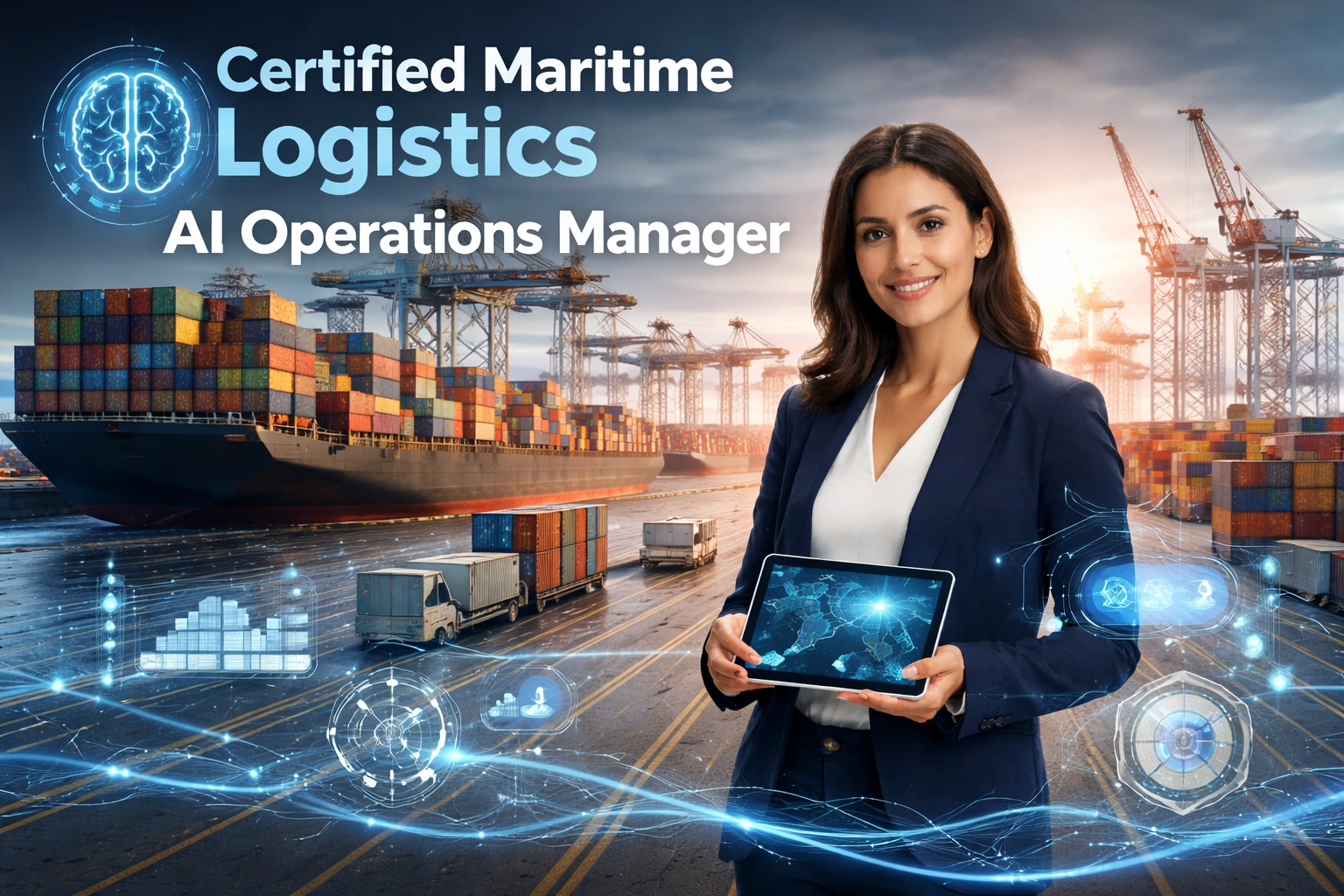
Certified Maritime Logistics AI Operations Manager | The Case HQ


Certified Maritime Logistics AI Operations Manager is a professional certification designed for maritime professionals, logistics managers, port operators, and supply chain leaders who want to harness the power of artificial intelligence to transform maritime logistics operations.

Global shipping and maritime logistics form the backbone of international trade, moving nearly 90% of the world’s goods across oceans and ports. However, the complexity of modern supply chains, increasing port congestion, rising fuel costs, and unpredictable global disruptions require smarter and more data-driven operational strategies. Artificial intelligence is rapidly becoming a critical tool for maritime organisations seeking to improve operational efficiency, reduce risks, and enhance supply chain visibility.

The Certified Maritime Logistics AI Operations Manager course provides a practical understanding of how AI technologies can be applied across maritime logistics operations. From predictive vessel routing and cargo demand forecasting to intelligent port management and automated logistics systems, this course explores how AI is reshaping the future of maritime transport and global supply chains.

Participants will learn how AI-powered analytics can support decision-making in shipping operations, optimise cargo flows across international logistics networks, and enhance operational performance within ports and maritime infrastructure. The course also examines how AI can improve predictive maintenance for vessels and equipment, strengthen supply chain resilience, and enable smarter maritime logistics planning.

Modern maritime operations generate enormous volumes of data from vessel sensors, port management systems, cargo tracking platforms, and logistics networks. Artificial intelligence allows organisations to transform this data into valuable operational insights. By analysing patterns in shipping routes, cargo flows, weather conditions, and port activity, AI systems can forecast operational disruptions, optimise vessel scheduling, and reduce delays in cargo handling.

The course also introduces the concept of smart ports, where artificial intelligence, automation, and digital technologies work together to create intelligent maritime logistics environments. Smart ports use AI-powered traffic management systems, automated container handling, and predictive logistics planning to significantly improve operational productivity and safety.

Designed for professionals working in shipping companies, port authorities, maritime logistics organisations, and global supply chain networks, the Certified Maritime Logistics AI Operations Manager certification equips learners with the strategic knowledge and operational frameworks required to implement AI solutions within maritime environments.

By completing this course, participants will gain the ability to evaluate AI technologies, understand their applications in maritime logistics, and lead digital transformation initiatives within shipping and port operations.

https://thecasehq.com/product/certified-maritime-logistics-ai-operations-manager-professional/?fsp_sid=5808

Comments

Popular posts from this blog

Top Picks: Best AI Tools for Academic Researchers in 2025

The academic research landscape is being transformed by artificial intelligence. From streamlining literature reviews to automating tedious formatting, the best AI tools for academic researchers in 2025 are reshaping how scholars plan, write, publish, and collaborate. This comprehensive guide introduces the top AI-powered platforms researchers should know about in 2025—each selected for its innovation, usability, and impact on scholarly productivity. Inspiring Innovation Through Case Studies: A Deep Dive 1. Elicit by Ought – AI Literature Review Assistant Best For: Structuring literature reviews and discovering relevant research papers Elicit uses machine learning to extract key findings from scholarly articles based on your research question. It summarises methodologies, conclusions, and limitations across multiple sources, making it perfect for early-stage PhD students and literature-heavy fields like social sciences and education. Features: Semantic search for academic questions K...

Top-Rated AI Assessment Tools for Schools and Universities in 2025

AI assessment tools for schools and universities are revolutionising how educators evaluate student performance, provide feedback, and design data-driven learning strategies. As educational institutions worldwide embrace digital transformation, the integration of artificial intelligence into assessment processes has become not only desirable but essential for efficiency, accuracy, and scalability. Traditional methods of assessment—while foundational—are often limited by time constraints, subjective marking, and lack of real-time feedback. By contrast, AI assessment tools for schools and universities offer powerful capabilities such as instant grading, adaptive questioning, and predictive analytics, enabling educators to focus more on teaching and student support. Why AI Assessment Tools Are Gaining Ground The push toward personalised learning, combined with the administrative burden on educators, has made AI tools a game-changer in education. From formative quizzes and essays to larg...

From Traditional to Transformative: The Evolution of Pedagogy in Modern Education

Pedagogy—the art and science of teaching—has undergone profound change over the past century. The shift from teacher-centred instruction to learner-centred approaches marks a critical chapter in the evolution of pedagogy . Today, teaching is no longer just about transferring knowledge; it is about cultivating critical thinking, creativity, and collaboration in dynamic and inclusive learning environments. This post explores how pedagogy has evolved, compares traditional and modern methods, and highlights the transformative practices redefining 21st-century education. The Role of Case Studies in Academic Research: Best Practices 1. Traditional Pedagogy: A Foundation Rooted in Authority and Rote Learning In traditional classrooms, the teacher is the central figure of authority, and learning is a linear, structured process. The focus is on content mastery, memorisation, and standardised assessment. Characteristics of traditional pedagogy: Teacher-centred instruction Passive student roles E...