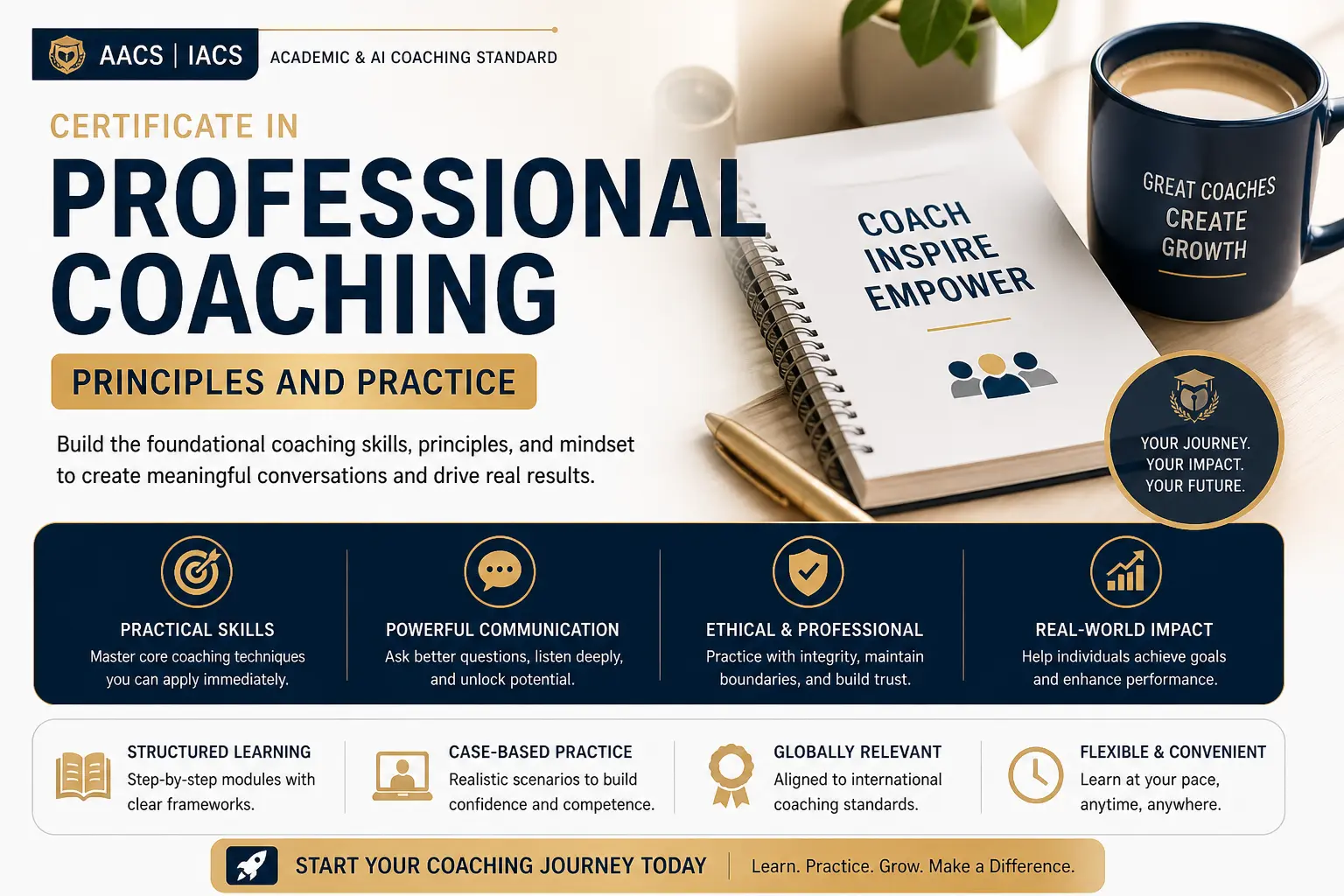
Professional Coaching Certification is rapidly becoming one of the most valuable credentials for individuals seeking to enhance performance, leadership capability, and career progression in today’s complex professional environments. The Certificate in Professional Coaching Principles and Practice has been carefully designed to provide a structured and practical foundation in coaching, enabling learners to develop essential coaching skills that are immediately applicable across academic, corporate, and AI-driven contexts.
In a world where professionals are expected to lead, influence, and develop others, coaching is no longer optional, it is a critical capability. This Professional Coaching Certification introduces learners to the principles, frameworks, and techniques required to conduct effective coaching conversations that drive measurable outcomes.
Why Professional Coaching Certification Is Essential Today
The demand for coaching skills has increased significantly across industries. Organisations now expect professionals not only to perform but also to support the development of others. In academic settings, faculty are required to mentor students and junior colleagues. In corporate environments, managers are expected to adopt a coaching mindset to enhance engagement and productivity.
Despite this growing demand, many professionals lack formal training in coaching. This Professional Coaching Certification addresses that gap by providing a clear, structured pathway to develop coaching capability grounded in professional standards.
Unlike informal mentoring or advice-giving, coaching requires discipline, structure, and ethical awareness. This certification ensures that learners understand how to engage in coaching in a way that is both effective and professionally responsible.
Understanding Coaching Principles and Professional Practice
A key component of this Professional Coaching Certification is the development of a clear understanding of coaching principles. Learners explore what coaching is, how it differs from mentoring, consulting, and counselling, and why these distinctions matter in professional practice.
The programme introduces structured coaching methodologies that enable learners to guide conversations effectively. Rather than relying on intuition, learners are equipped with proven frameworks that support goal setting, reflection, and action planning.
This structured approach ensures that coaching conversations are purposeful, consistent, and outcome-driven.
Developing Core Coaching Skills for Real-World Application
Effective coaching depends on the ability to communicate with clarity, empathy, and precision. This Professional Coaching Certification places strong emphasis on developing:
- Active listening skills
- Powerful questioning techniques
- Constructive feedback methods
Learners are trained to move beyond surface-level communication and engage in meaningful dialogue that promotes insight and behavioural change. These skills are essential not only for coaching but also for leadership, teaching, and professional collaboration.
In addition, learners practise structuring coaching sessions using recognised models such as GROW and CLEAR. These models provide a practical framework for guiding conversations from initial goal setting through to action and accountability.
Ethical Coaching Practice and Professional Standards
Ethics is a fundamental aspect of professional coaching. Without trust, coaching cannot be effective. This Professional Coaching Certification introduces learners to key ethical principles, including:
- Confidentiality and data protection
- Professional boundaries
- Responsible coaching engagement
Understanding and applying these principles ensures that coaching relationships are built on trust and integrity. It also prepares learners to operate in professional environments where ethical accountability is essential.
Coaching in Academic, Career, and AI-Driven Contexts
One of the distinguishing features of this Professional Coaching Certification is its relevance to modern professional environments. Coaching today must adapt to:
- Academic performance pressures
- Career transitions and reinvention
- Rapid technological change driven by artificial intelligence
Learners are introduced to coaching applications within these contexts, enabling them to support individuals facing real-world challenges. Whether working with students, professionals, or teams, learners will be able to apply coaching techniques that are relevant and impactful.
Reflective Practice and Continuous Development
Professional coaching is not a static skill—it requires ongoing reflection and improvement. This Professional Coaching Certification incorporates structured reflective practice, enabling learners to evaluate their own coaching effectiveness.
Through guided reflection, learners develop the ability to:
- Identify strengths and areas for improvement
- Adapt coaching approaches to different situations
- Continuously enhance their professional capability
This emphasis on reflection ensures long-term development and supports progression into advanced coaching certifications.
Practical Learning Through Case-Based Coaching
To ensure practical relevance, this Professional Coaching Certification includes case-based learning and applied coaching scenarios. Learners engage with realistic situations that simulate coaching interactions in academic, career, and organisational settings.
This approach ensures that learners are not only acquiring knowledge but also developing the confidence to apply coaching techniques in real-world contexts.
Who Should Enrol in This Professional Coaching Certification
This certification is suitable for a wide range of learners, including:
- Academics and educators seeking to support student development
- Professionals interested in transitioning into coaching roles
- Managers and leaders aiming to enhance team performance
- Individuals focused on personal and professional development
The programme is designed to be accessible to beginners while also providing sufficient depth to support progression into advanced coaching pathways.
Career Value of Professional Coaching Certification
Completing a Professional Coaching Certification demonstrates a commitment to professional development and the ability to support others effectively. Coaching skills are increasingly recognised as a critical competency across industries, enhancing employability and career progression.
This certification provides a strong foundation for further development in specialised areas such as academic coaching, leadership coaching, and AI-integrated coaching.
Start Your Coaching Journey with Confidence
The Certificate in Professional Coaching Principles and Practice serves as the foundation for building a professional coaching capability that is relevant, structured, and future-focused. By completing this Professional Coaching Certification, learners gain the knowledge, skills, and confidence required to support individuals and organisations in achieving meaningful outcomes.
This is not simply an introductory course, it is the first step in developing a capability that has the potential to transform careers, enhance performance, and create lasting impact.
Visit our other human resource certifications
Visit our other artificial intelligence certifications
Visit our other digital technology certifications
Visit our other higher education certifications
Visit our other quality and lean six sigma certifications
Visit our other strategy and management certifications
Visit our other maritime and shipping certifications
https://thecasehq.com/courses/certificate-in-professional-coaching-principles-and-practice/?fsp_sid=6193
Comments
Post a Comment