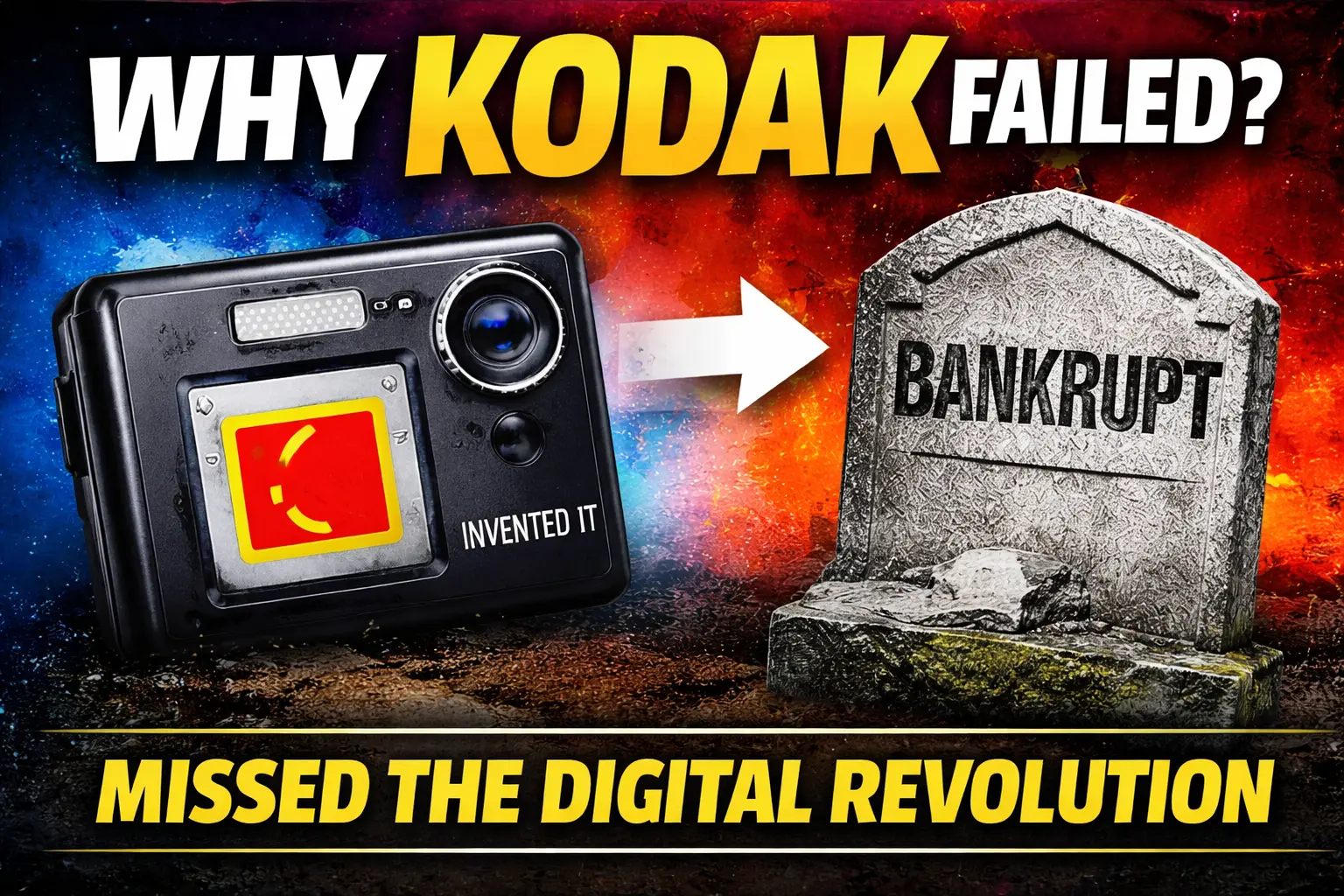
The Digital Paradox: Why Kodak Killed Its Greatest Invention


Kodak didn't just miss the digital revolution they invented it. In 1975, a Kodak engineer created the first digital camera, yet the company filed for bankruptcy in 2012. Why?


This The Case HQ case study explores the "Digital Paradox" and "The Innovator's Dilemma." We break down how Kodak, Blockbuster, and Nokia all fell into the same trap: refusing to disrupt their own successful business models. Learn the critical strategy lessons on why hardware-first companies fail to adapt to software-led shifts.


https://youtu.be/OX9RRr5nSpc


Strategic Breakdown: The 1975 Mistake: Why Kodak suppressed its own digital camera technology.


The Razor-and-Blade Trap: How high-margin film sales blinded management.


Parallel Failures: How Blockbuster and Nokia made the exact same errors. The Lesson: How modern industry leaders can avoid a "Kodak Moment."


Visit our website for latest courses: https://thecasehq.com/


Visit our AI Courses: https://thecasehq.com/artificial-intelligence-courses/


Visit our Digital Technology Courses: https://thecasehq.com/digital-technologies/


Visit our Higher Education Courses: https://thecasehq.com/higher-education-courses/


Visit our Quality and Lean Six Sigma Courses: https://thecasehq.com/quality-lean/


Visit our Strategy and Leadership Courses: https://thecasehq.com/strategy-and-management-courses/


Visit our Human Resource Courses: https://thecasehq.com/human-resources/


Visit our Maritime and Shipping Courses: https://thecasehq.com/maritime-shipping/


https://thecasehq.com/the-digital-paradox-why-kodak-killed-its-greatest-invention/?fsp_sid=6678

Comments

Popular posts from this blog

From Traditional to Transformative: The Evolution of Pedagogy in Modern Education

Pedagogy—the art and science of teaching—has undergone profound change over the past century. The shift from teacher-centred instruction to learner-centred approaches marks a critical chapter in the evolution of pedagogy . Today, teaching is no longer just about transferring knowledge; it is about cultivating critical thinking, creativity, and collaboration in dynamic and inclusive learning environments. This post explores how pedagogy has evolved, compares traditional and modern methods, and highlights the transformative practices redefining 21st-century education. The Role of Case Studies in Academic Research: Best Practices 1. Traditional Pedagogy: A Foundation Rooted in Authority and Rote Learning In traditional classrooms, the teacher is the central figure of authority, and learning is a linear, structured process. The focus is on content mastery, memorisation, and standardised assessment. Characteristics of traditional pedagogy: Teacher-centred instruction Passive student roles E...

Urgent Need for Addressing Bias in AI-Powered Assessment Tools

Addressing bias in AI-powered assessment tools is one of the most urgent challenges in educational technology today. While artificial intelligence has brought efficiency, scale, and speed to student assessment, it has also raised valid concerns about fairness, equity, and discrimination. As more institutions adopt AI to evaluate written work, analyse performance, and deliver feedback, ensuring that these tools operate without bias is not optional—it’s essential. Bias in AI systems often stems from the data used to train them. If training datasets are skewed towards a specific demographic—such as students from certain geographic regions, language backgrounds, or academic levels—the algorithm may unintentionally favour those groups. The result? An uneven learning experience where assessments do not reflect true student ability, and grading may be inaccurate or discriminatory. How to Use Case Studies to Showcase Your Expertise Why Addressing Bias in AI-Powered Assessment Tools Matters Ed...

Top-Rated AI Assessment Tools for Schools and Universities in 2025

AI assessment tools for schools and universities are revolutionising how educators evaluate student performance, provide feedback, and design data-driven learning strategies. As educational institutions worldwide embrace digital transformation, the integration of artificial intelligence into assessment processes has become not only desirable but essential for efficiency, accuracy, and scalability. Traditional methods of assessment—while foundational—are often limited by time constraints, subjective marking, and lack of real-time feedback. By contrast, AI assessment tools for schools and universities offer powerful capabilities such as instant grading, adaptive questioning, and predictive analytics, enabling educators to focus more on teaching and student support. Why AI Assessment Tools Are Gaining Ground The push toward personalised learning, combined with the administrative burden on educators, has made AI tools a game-changer in education. From formative quizzes and essays to larg...